Cartier · Tank Obus

Tank Obus Quadrant, 18k Gold and Enamel

Tank Obus Quadrantc. 1980s

The Cartier Tank Obus Quadrant is a 1980s Obus without a reference number, its Roman numerals in enamel on a wide bezel: an 18k gold square of 25 × 25 mm or 19 × 19 mm with bullet lugs and a quartz movement.

Have this watch?

We’re still gathering public results for the Tank Obus Quadrant, so there’s no honest number to show yet.

We’re opening a small panel of specialist dealers soon. Leave your email and we’ll write once, when they’re ready to bid on your watch. Nothing else.

Reference photography unavailable.

Want to sponsor this reference with your studio photography? Become a sponsor

Specifications

Reference
Tank Obus Quadrant
No reference number; case numbers begin A100 or A101; 18k gold, enamel numeral bezel, quartz
Year
c. 1980s
Christie's dates one example circa 1985 and an earlier one of the same design circa 1980; Monaco Legend, Fortuna and Amsterdam Watch Company catalog examples as 1980s
Movement
Quartz
Cartier quartz movement, caliber not named in the catalogs consulted; Christie's records a c. 1980 example of the same design with a hand-wound Cal. 21, 17 jewels
Case
25 × 25 mm or 19 × 19 mm, 18k Yellow Gold (white gold documented)
Square, wide enamel bezel, bullet-shaped (Obus) lugs
Dial
White
Matte white, off-white, ivory or silvered, signed only Cartier and Paris; the Roman numerals are on the bezel, in enamel (usually blue) with an inner enamel minute track
Hands
Blued steel
Épée (sword-shaped)
Crystal
Sapphire or mineral glass
Antiquorum records sapphire on a white gold example; Amsterdam Watch Company lists mineral glass on a yellow gold one
Strap
Leather or 18k gold bracelet
Leather strap with an 18k gold Cartier deployant buckle, or an 18k gold bracelet; Antiquorum records a white gold Cartier link bracelet with concealed double deployant clasp

Visual Description

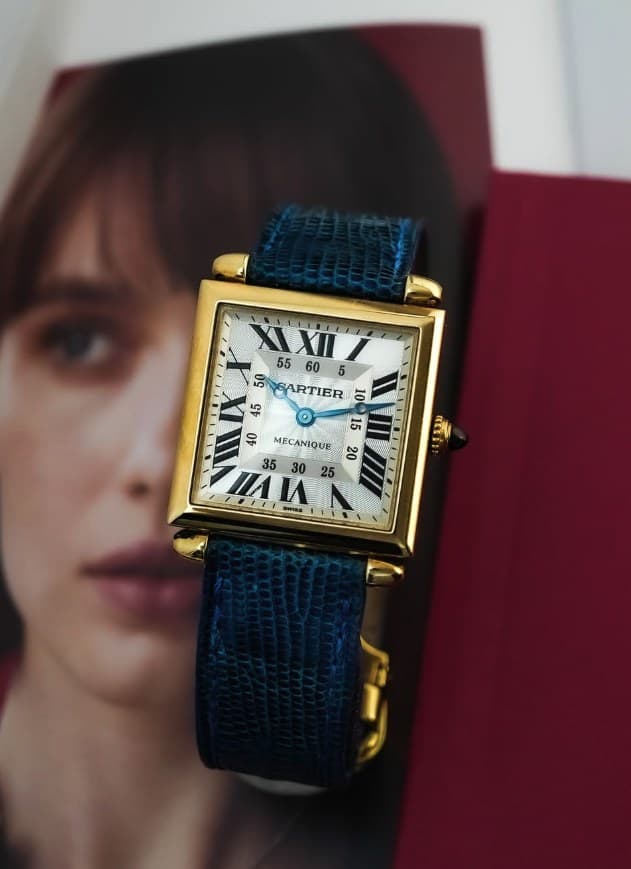
The Quadrant is a square Tank Obus whose Roman numerals sit on the bezel rather than the dial. A wide bezel carries the hours in blue enamel, with an inner enamel minute track, around a plain matte white dial signed only Cartier at the top and Paris at the bottom. Monaco Legend describes the enamel as champlevé and the hands as blued steel épée.

The case is 18k gold with the bullet-shaped lugs of the Obus, a beaded crown set with a cabochon sapphire and a back held by four screws in the band. It comes in two sizes, about 25 mm and 19 mm square, on a leather strap with an 18k gold Cartier deployant buckle or on a gold bracelet. Christie's catalogs the large size at 25 mm square.

Reference Significance

The Quadrant moves the numerals of the Tank Obus from the dial to the bezel. Where the quartz Ref. 1630 has painted black Roman numerals, a railroad minute track and the hidden signature at VII on a silvered dial, the Quadrant leaves the dial bare except for Cartier and Paris and sets the hours in enamel around it.

No catalog gives it a reference number of its own. Christie's lists it by name as the Quadrant, and the numbers on its case backs, which begin A100 or A101, are case numbers shared across both sizes rather than a reference.

Historical Context

The Quadrant belongs to the 1980s. Fortuna writes that Cartier introduced it among many new models of the decade, and auction houses date examples to the 1980s, one to circa 1985.

Christie's has cataloged the earliest dated example of the design, a 25 mm watch of about 1980 with a hand-wound Cal. 21, without the Quadrant name, and notes that the design is illustrated in Le Temps de Cartier by Barracca, Negretti and Nencini. Every example cataloged under the Quadrant name in the records we opened is quartz.

Cartier came back to the idea later. A Tank Obus of about 1996, cataloged as the Rectangulaire à Pattes Vis Armurier, also has Roman numerals on an enamel bezel, but in black, on a case of about 23 × 24 mm with a guilloché dial and a hand-wound movement. It is a different watch from the Quadrant.

What to Look For

Start with the enamel. The numerals and minute track on the bezel should be complete, even in color and free of chips, cracks or retouching. Then check the bullet lugs under magnification for dents, asymmetry and polishing, as on any Obus.

Turn the watch over. The back should be held by four screws in the band, and the case should carry a number beginning A100 or A101; Monaco Legend and Fortuna record A100721 and A101494 on yellow gold examples. The dial should carry only the Cartier and Paris signatures, with no numerals, and the hands should be blued steel épée. A quartz movement is expected, apart from the rare early hand-wound example.

Original Cartier gold bracelets, deployant buckles, boxes and warranty papers have survived with several examples. They help confirm the size, metal and date of an example and make it more desirable.
Known Variants

Documented dial, case, and bracelet variations of Tank Obus Quadrant.

Large, Blue Enamel, 18k Yellow Gold

About 25 mm square, blue champlevé enamel numerals and minute track, quartz, on a leather strap with an 18k gold Cartier deployant buckle. Christie's dates one to circa 1985; Fortuna and Monaco Legend have offered others with Cartier boxes and papers.

c. 1980sThe most often documented version

Small, Blue Enamel, 18k Yellow Gold

About 19 mm square with the same blue enamel bezel, quartz. Monaco Legend offered one on its original yellow gold bracelet; Amsterdam Watch Company lists another with Cartier service papers.

1980sUncommon

Small, Black Enamel, 18k White Gold

19 × 19 mm and 5 mm thick, black champlevé numerals, ivory dial, sapphire crystal, on an 18k white gold Cartier link bracelet with concealed double deployant clasp. Antiquorum sold one in 2013, cataloged as a Tank Obus, case number A100623.

1980sRare; one example documented

Red Enamel, 18k Yellow Gold

Red enamel numerals on the bezel, a white Paris dial and blued sword hands, about 25 mm. Analog/Shift has sold examples listed as a Cartier Obus and dated to the 1980s.

1980sRare

Early Hand-Wound Example

25 mm wide with blue enamel numerals and an inner blue enamel railway minute track, a hand-wound Cal. 21 with 17 jewels and a gilt Cartier buckle. Christie's cataloged it circa 1980, case number A 100'164, without the Quadrant name.

Circa 1980One example documented

How to tell it apart

What separates the Tank Obus Quadrant from its neighbors, and what to check before you buy or sell one.

What is the Cartier Tank Obus Quadrant?

A square Tank Obus of the 1980s with its Roman numerals in enamel on a wide bezel and a plain dial signed only Cartier and Paris. The 18k gold case has the bullet-shaped lugs of the Obus and a cabochon sapphire crown, the movement is quartz, and it was made in two sizes, about 25 mm and 19 mm square. Christie's catalogs it as the Quadrant and Monaco Legend as the Obus Quadrant.

Is A100 the reference number?

No catalog we opened calls it one. Case numbers recorded by Christie's, Antiquorum, Monaco Legend and Fortuna run from A 100'164 to A101494 and cover both sizes and more than one enamel color, so A100 is the start of a case number, not a reference that identifies one version. Some dealers list the case number as the reference, as Amsterdam Watch Company does with A101185. That is why this page names the watch rather than giving it a number.

How do I tell a Quadrant from a Tank Obus Ref. 1630?

Look at where the numerals are. The Ref. 1630 is a 24.5 × 31 mm quartz Obus with black Roman numerals, a railroad minute track and the hidden signature at VII painted on a silvered dial, and blued Breguet-style hands. The Quadrant's numerals are enamel on the bezel, its dial carries only Cartier and Paris, and its hands are épée. The 1630 has its reference on the case back; the Quadrant has a case number beginning A100 or A101.

What sizes and colors was the Quadrant made in?

Two sizes are documented: about 25 mm square (Christie's and Fortuna) and 19 mm square (Monaco Legend and Amsterdam Watch Company). Blue enamel on yellow gold is the usual combination. Antiquorum has sold a 19 mm white gold example with black enamel numerals, and Analog/Shift yellow gold examples with red enamel; both listed them as a Tank Obus or Cartier Obus rather than by the Quadrant name.

Is the Quadrant quartz or mechanical?

Most examples are quartz. Christie's has cataloged one early example of the same design, circa 1980 and 25 mm wide, with a hand-wound Cal. 21 of 17 jewels, without the Quadrant name. A hand-wound example is possible but rare, and the movement should be signed Cartier either way.

What should I check before buying a Quadrant?

The enamel bezel first, for chips, cracks or retouching; then the bullet lugs for dents and polishing; a dial signed only Cartier and Paris with blued épée hands; a case back held by four screws, with a case number beginning A100 or A101; a cabochon sapphire crown; and a Cartier movement, quartz on most examples. An original Cartier bracelet or deployant buckle, box and papers add to a Quadrant.