Visual Description
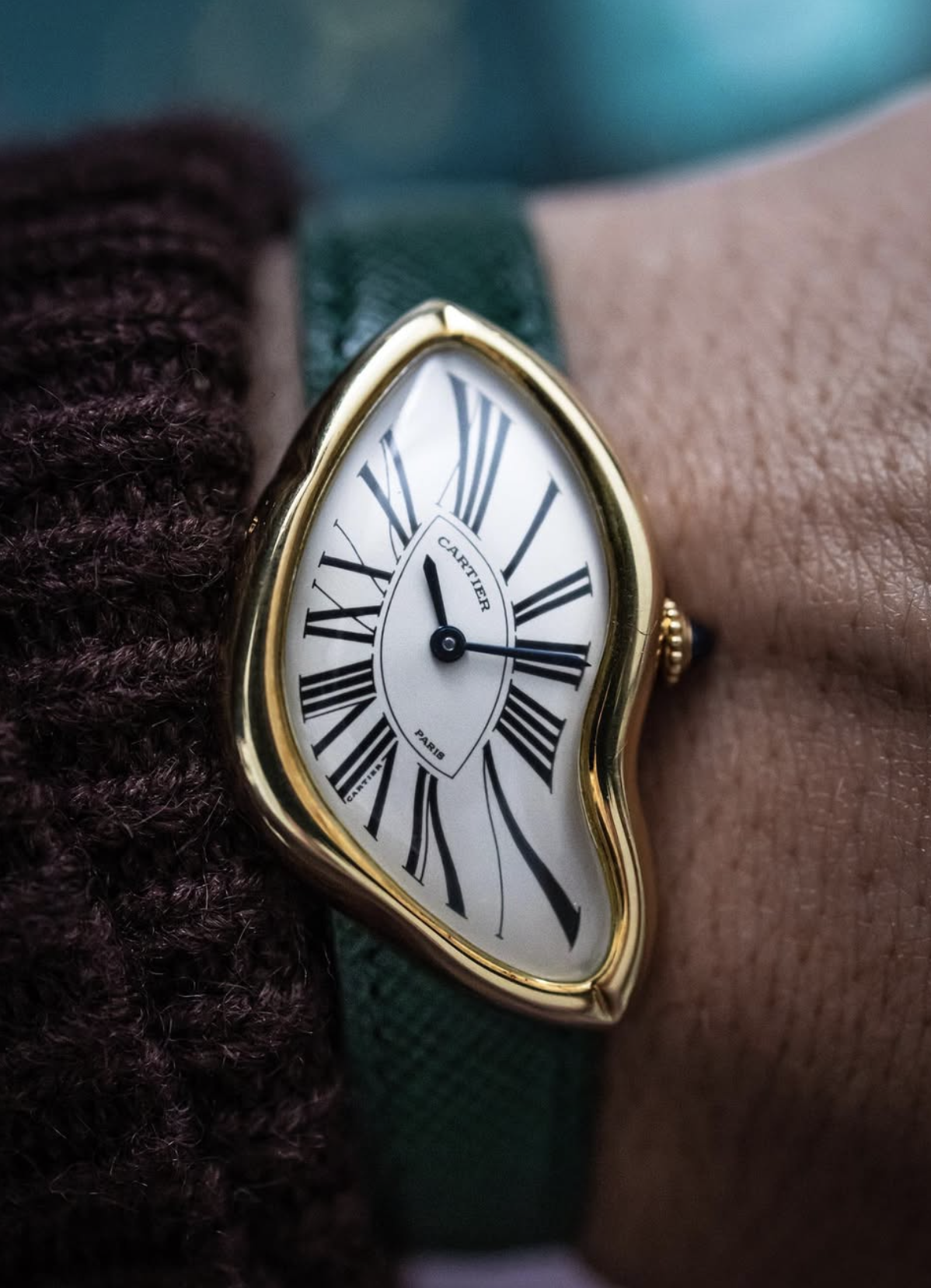
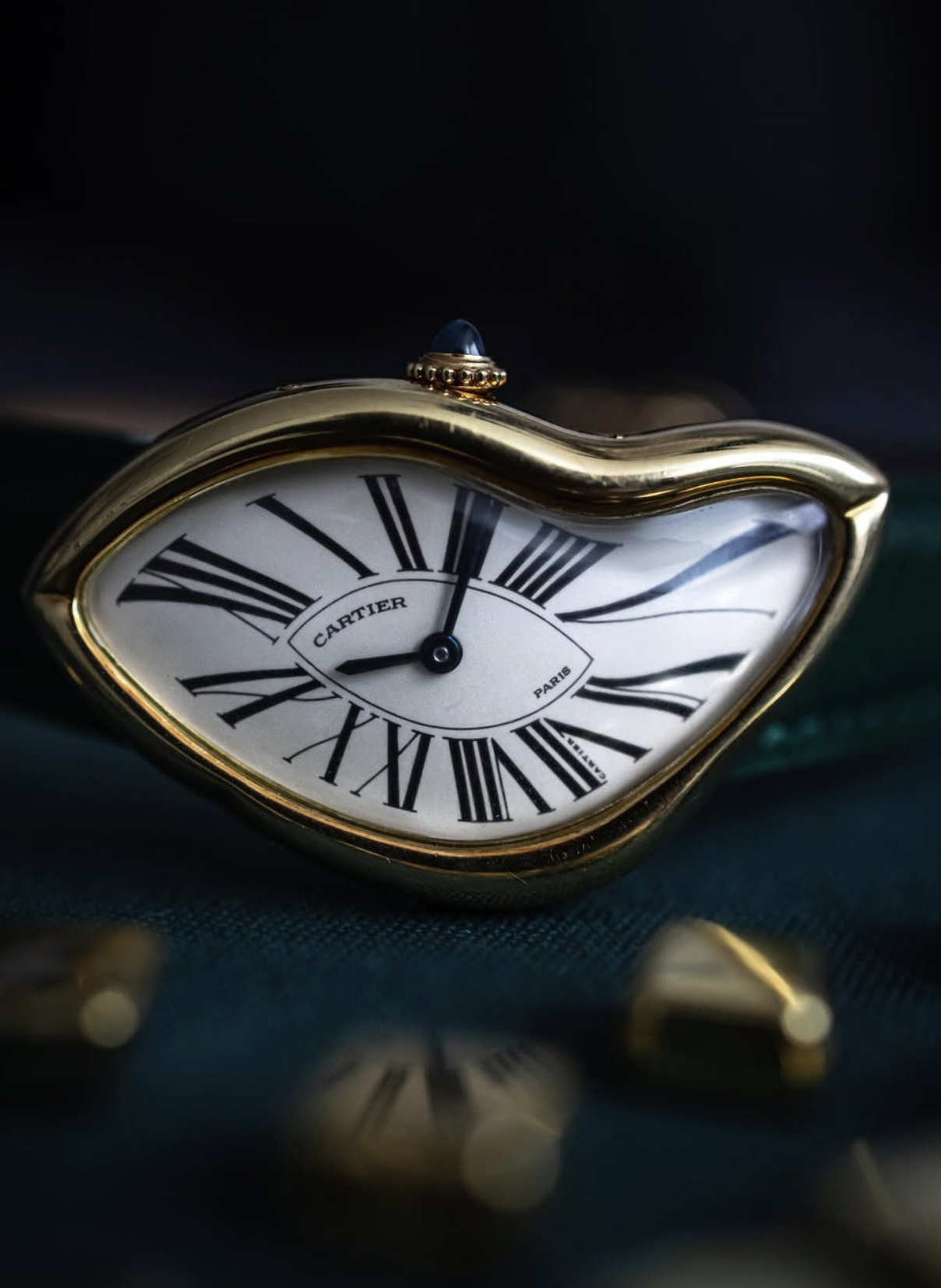
The Paris 1991 Crash is a faithful reinterpretation of the London original, scaled down slightly to 38.5 × 22.5 mm but preserving the essential character of the melted, asymmetric form. The 18k gold case — available in yellow, white, and rose gold — flows across the wrist with the same surreal contours as its predecessor. The champagne dial carries distorted Roman numerals that follow the case's impossible geometry, with "CARTIER" at 12 o'clock and "PARIS" at 6 o'clock. Blued steel sword hands move through this distorted field.
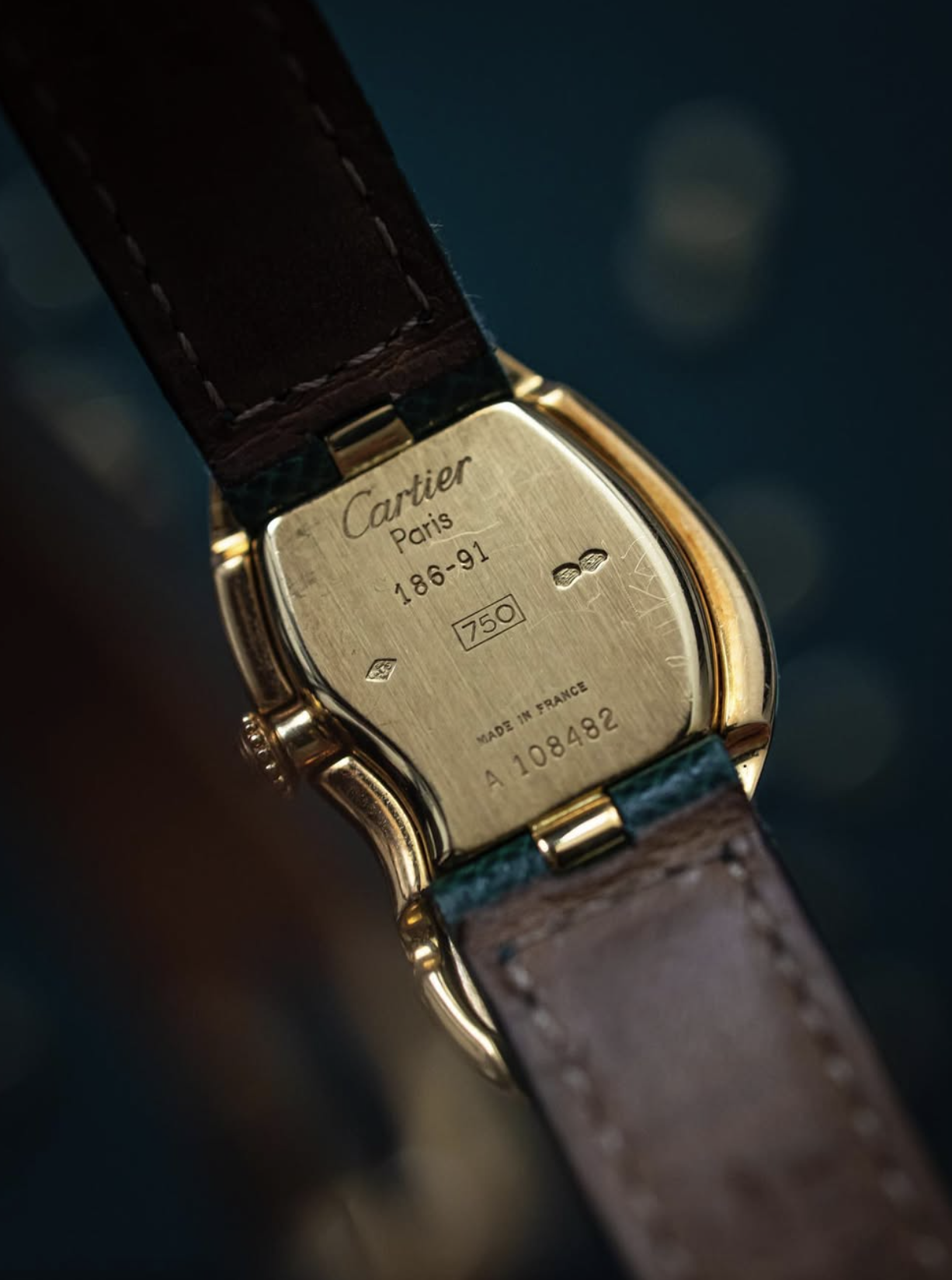
The case back carries the individual production number (e.g., "N° 127/400"), making each piece uniquely identifiable within the limited run. The overall proportions are slightly more refined than the London original — the 1991 edition benefits from more precise modern case-making techniques while retaining the hand-finished quality that the Crash's complex form demands.
Reference Significance
The Paris 1991 edition is the most important Crash reissue and the practical entry point for serious Crash collecting. Where the London originals exist in a stratosphere of rarity that places them beyond most collectors' reach, the 400-piece Paris run created a meaningful — if still very limited — pool of available pieces.
The significance of the 1991 edition goes beyond accessibility. It was the first time Cartier officially acknowledged and re-produced the Crash design, validating the London workshop's radical experiment as part of the maison's canon rather than a one-off curiosity. The choice to produce it as a numbered limited edition, rather than as a standard catalog reference, signals that Cartier understood the Crash's value lay precisely in its scarcity and provocation.
The Cal. 160 manual-wind movement represents a transition from the JLC-supplied calibers of the London era to Cartier's own movement sourcing. While less historically significant than the London original's JLC Cal. 841, the Cal. 160 is a reliable, well-finished movement appropriate to the watch's positioning.
At auction, Paris 1991 Crashes have appreciated substantially, particularly in the post-2018 vintage Cartier boom. Prices vary significantly by metal — rose gold examples, being the rarest, command the highest premiums, while yellow gold pieces represent the most liquid market.
Historical Context
By 1991, Cartier had been under Richemont Group ownership for several years, and the maison was beginning to mine its archival heritage for commercial and cultural capital. The Crash reissue was part of this broader strategy: honoring the London workshop's legacy while introducing its most daring design to a generation of collectors who had never seen the original.
The limited edition of 400 pieces was produced in Paris — a symbolic choice, given that the original was a London creation. The production run was small enough to maintain exclusivity but large enough to generate press attention and establish the Crash as a recurring presence in Cartier's horological vocabulary. The 1991 edition effectively built the market for the Crash as a collectible category, driving interest back to the London originals and forward to subsequent reissues.
The 1997 Rue de la Paix edition of 13 pieces followed as an even more exclusive micro-edition, further layering the Crash's limited-production mystique.
What to Look For
Authentication begins with the case back numbering. Every Paris 1991 Crash carries an individual number out of 400 — if this engraving is absent, poorly executed, or shows signs of addition after manufacture, the piece warrants immediate suspicion. The numbering should be crisp, evenly spaced, and consistent with Cartier's engraving standards of the period.
The dial should read "CARTIER" at 12 o'clock and "PARIS" at 6 o'clock. The distorted Roman numerals should follow the same deformation pattern as the case contours — on counterfeits, the numeral distortion often appears random rather than following the organic logic of the asymmetric case.
The Cal. 160 movement should be visible through the case back on most examples. Verify that it shows Cartier finishing and markings consistent with early 1990s production. The 18k gold hallmarks should match the stated metal — yellow, white, or rose gold — and be consistent with French or Swiss hallmarking conventions of the period.
Case condition matters significantly. As with all Crash references, the asymmetric form is extremely difficult to polish correctly, and over-polishing permanently degrades the flowing contours. Look for crisp transitions between the polished and brushed surfaces, and check that the lug attachments show their original geometry. The individual production number on the case back is essential for establishing the piece's identity within the 400-piece run — any Crash offered as a Paris 1991 edition without a legible number deserves scrutiny.