Visual Description
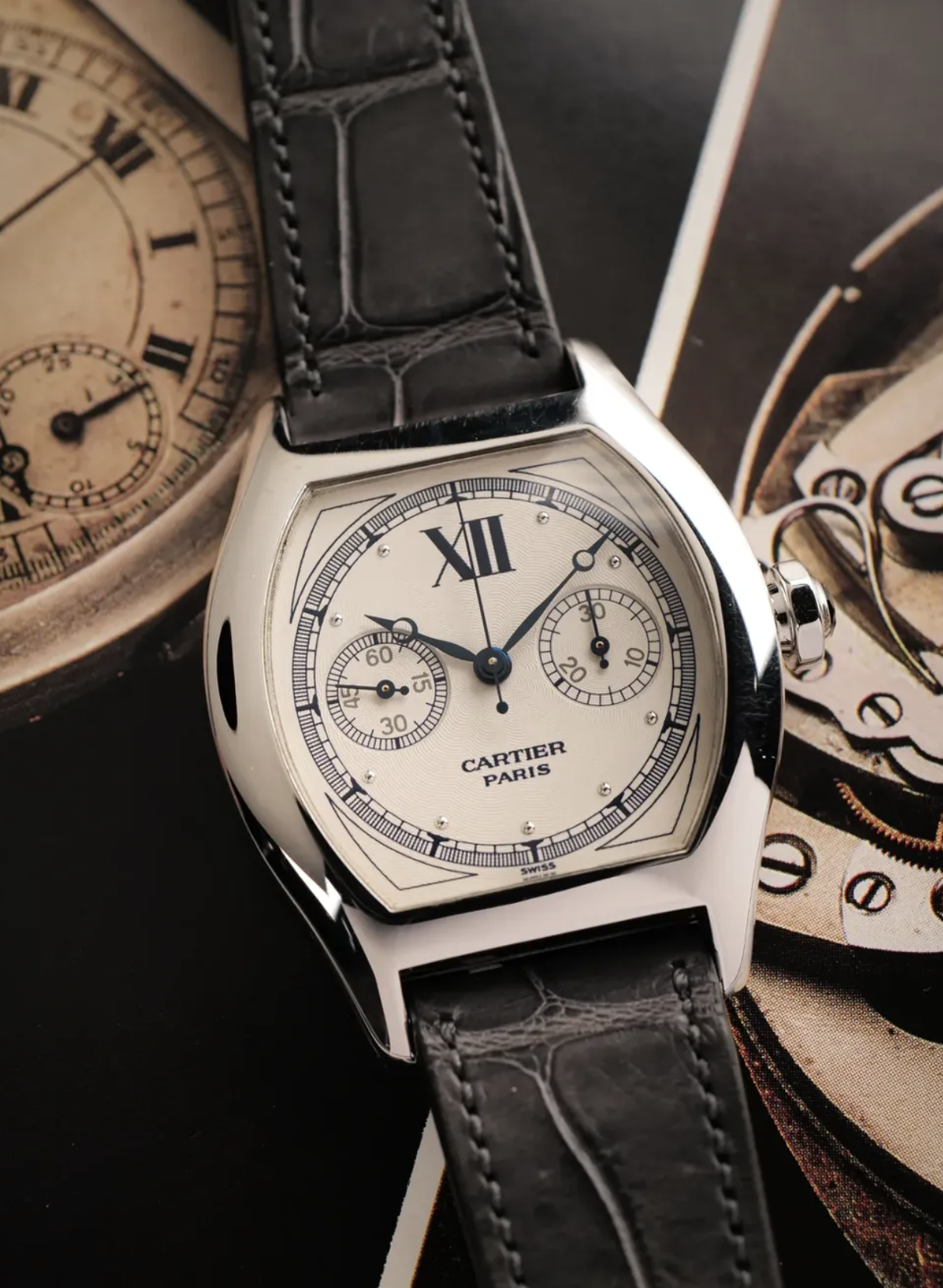
The Ref. 2396 is a compact chronograph study in restrained elegance. Its white gold tonneau case measures a precise 34 × 43 mm, small enough to appeal to vintage sensibilities yet substantial enough to project mechanical authority. The proportions are distinctly early Cartier—the tonneau form echoes the original 1912 heritage, but the execution is firmly contemporary.
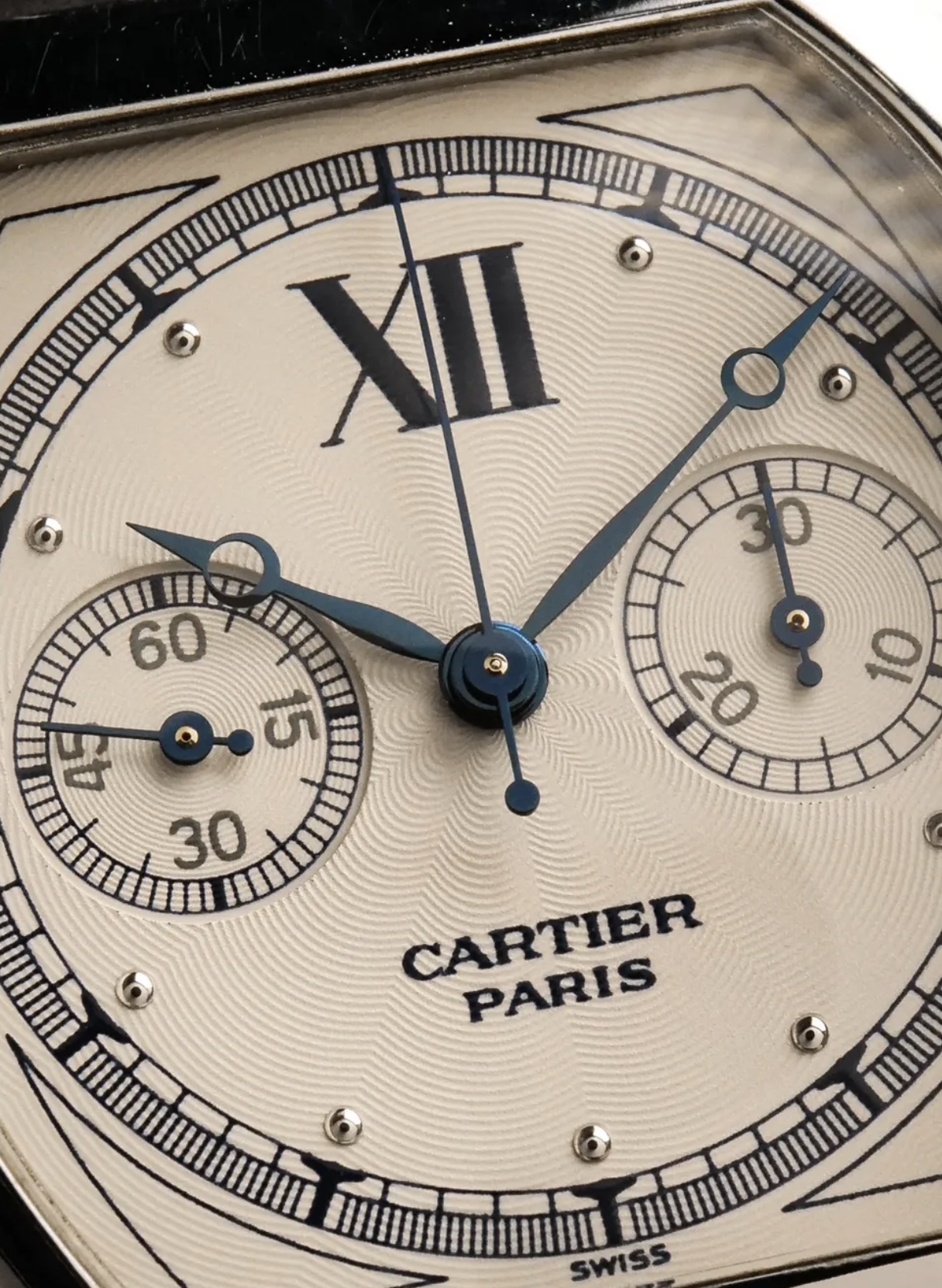
The dial presents a refined two-counter chronograph layout: a 30-minute counter at 3 o'clock and a running-seconds subdial at 9 o'clock, both rendered in understated black numerals against the silver-white ground. The hour and minute hands are characteristic Cartier blue sword profiles, elegant and readable. The chronograph hand, blued steel, stands apart through material and finish—a deliberate distinction that reinforces functional hierarchy.
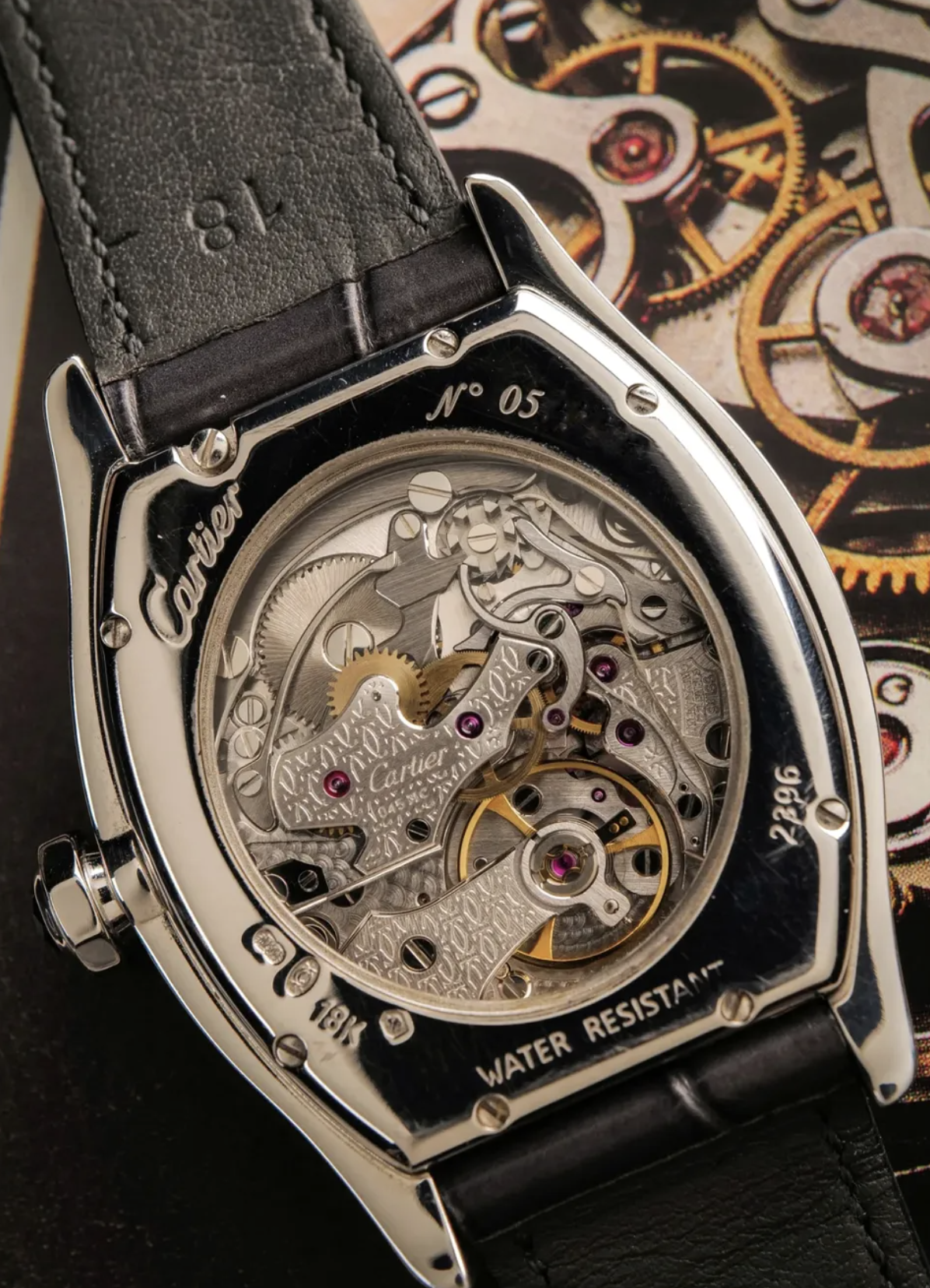
The caseback is mineral, not sapphire, allowing inspection of the movement without the distortion of crystal magnification. Beneath lies the 045MC caliber, its jewels and screws visible as a geometric exercise in restraint. The 18k white gold deployant clasp sits flush with the case, and the blue sapphire cabochon crown, set in white gold, completes the color and material story with precision.
Reference Significance
The Ref. 2396 occupies a rare position in Cartier's modern horology: a privately-issued, chronograph-equipped sport watch that refuses commercialism. CPCP (Collection Privée Cartier Paris) references were produced in severely limited quantities, often fewer than 500 examples globally, for a clientele that valued exclusivity and mechanical sophistication equally.
This reference is significant for three distinct reasons:
Mechanical innovation: The monopoussoir chronograph—a single-button start/stop/reset mechanism—is a high-order complication. Cartier typically reserved such movements for house-name complications (Pasha, Roadster). To apply it to a Tortue revival demonstrates that the model retained prestige sufficient to warrant investment in complex calibers.
Movement sourcing: The 045MC is built on Piaget's proven 1285P platform, a relationship that speaks to Cartier's technical confidence. Piaget movements were not applied casually to Cartier cases; they represented a deliberate claim to mechanical excellence. The 22-jewel configuration and 4 Hz frequency deliver chronometric capability rarely seen in watches of this aesthetic restraint.
Design coherence: The Ref. 2396 successfully reconciles the Tortue's historical identity—a dress tonneau from 1912—with late-1990s sport-watch aspiration. It is neither a pastiche nor a radical reinterpretation; it is a thoughtful evolution that asked what the original might have become if given access to modern materials and techniques.
Historical Context
The late 1990s represented a moment of technical awakening in watchmaking. The quartz crisis had abated; mechanical watchmaking, once left for dead, had regained prestige. Cartier, as luxury's preeminent brand, began exploring what a mechanical Cartier could be beyond the Pasha and Santos, its defining modern icons.
The CPCP program itself was a direct response to collector demand for exclusivity and complication. Between 1998 and 2002, CPCP released a series of sport watches—chronographs, tourbillons, and perpetuals—in materials and configurations never available to the general market. The Tortue Chronograph was positioned as a statement of heritage revival: proving that an early Cartier shaped case could hold its own alongside modern sport complications.
Production of the Ref. 2396 was estimated at 300–500 examples across two years, distributed primarily to Cartier VIP clients and select retailers. No public marketing accompanied the release; ownership was conveyed through dealer relationships and word-of-mouth among collectors. This opacity is now an asset—CPCP watches, freed from marketing narrative, carry authenticity of purpose.
The watch arrived at a moment when single-button chronographs were themselves experiencing revival interest. Collectors were re-examining movements like the Valjoux 7750 and its hand-wound relatives with fresh appreciation. The 045MC, being a hand-wound monopoussoir, aligned perfectly with this sentiment.
What to Look For
Dial condition: The silver-white dial should be clean and unblemished. Original dials are unmarked in production; if you see any service marks, refinishing evidence, or fading, the watch has been restored. CPCP references deserve original dials—refinishing on a limited-edition model significantly reduces value.
Chronograph function: Test the monopoussoir mechanism through a full cycle. Press once to start the hand; it should snap from rest with audible precision. Press again to stop; the hand should freeze instantly. Press a third time to reset to zero. Any hesitation, stickiness, or failure to reset cleanly indicates movement service or wear. A properly functioning monopoussoir is a pleasure; dysfunction is a red flag.
Movement condition: Request images or a video of the caseback with the movement in motion (ticking, not running). Inspect for:
- Clean jewels and screw heads (no green oxidation or corrosion)
- Even, visible ticking in the balance wheel
- No hairspring damage or obvious service marks
- Blued screws should appear uniform in color (not overheated to a straw or brown tone)
Case and lugs: The tonneau case should show no polishing damage, case separations, or ding repair. The lugs should be symmetrical and smooth; any repairs or welding is visible under close inspection and detract significantly from value. Sapphire crystal should be free of scratches; replacements are common and reduce authenticity.
Documentation and packaging: CPCP references often shipped with numbered certificates, warranty cards, and presentation boxes. Original packaging increases value by 20–30%. Verify that any documentation matches the serial number on the caseback.
Strap condition: The original brown crocodile strap should show only light wear if the watch was genuinely less-worn. Crocodile leather cracks and fades; restoration or replacement is common. If the original strap is present and intact, this is a material asset. Modern leather straps are replacements and should be factored into pricing accordingly.
Service history: CPCP watches are increasingly 20+ years old. A documented service history—ideally at a Cartier boutique—adds value. Movement servicing at non-Cartier watchmakers can be acceptable if performed by recognized specialists, but factory service carries the most weight.
Collector Notes
The Ref. 2396 represents a high-water mark for Cartier's mechanical watch aspirations in the CPCP program. A clean example with original dial, functional chronograph, and documented service history is considered a significant collector acquisition—a reference that holds ground against more famous complications from brands like Patek Philippe or Audemars Piguet, despite Cartier's smaller collector base.
Prices for mint examples typically range from $12,000–$18,000 USD, depending on provenance and documentation. Worn or serviced examples fall into the $8,000–$12,000 range. CPCP references from this era have shown modest appreciation, as collector awareness has grown and production numbers became known to be extremely limited.
The Tortue's positioning as a "vintage-inspired" modern watch has also aged well. Where some 1990s revivals feel dated or over-designed, the Ref. 2396's restraint has allowed it to sit comfortably in contemporary conversations about vintage sports watches.