Identification
How to read a Cartier case back.
Turn the watch over. Nearly everything the archive needs to name your watch is engraved on the back: the reference that says which model it is, the serial that says which one is yours, the metal, and where it was made. This page shows you which line is which, so you can find the reference page yourself and create a record in a few minutes.
Spaces, dashes and the word “Ref.” are ignored. If you are not sure which number is the reference, try each; the serial will not match anything, the reference will.
What you will find
- The signature
- Cartier in script, sometimes with Paris beneath it on watches cased in Paris in the 1970s and 1980s. Les Must de Cartier pieces say must de Cartier instead.
- The reference
- The number that names the model: four digits (1713, 2396), five (78086, 96069) or six (887904, 366001) depending on the generation. Every watch of that model carries the same reference, which is why the archive is indexed by it. Modern boutique codes such as W51008Q3 are catalogue references and are usually not on the case; the archive lists those too.
- The serial
- The number that is yours alone, usually directly beneath the reference: six digits on many 1980s and 1990s pieces, two letters and digits on later ones. It goes on your record, where only you and, if you sell, the winning dealer can see it. It is not the number to search.
- The metal
- 18K or 750 for 18-karat gold; 925 or Argent for sterling silver; Plaqué with a figure for gold plating over another metal. A Must with Argent and a gold color is vermeil: silver under a layer of gold, which is what it was sold as. Steel usually says Acier or Stainless Steel, or nothing at all.
- Origin and construction
- Swiss Made, Water Resistant, Quartz or Automatique. Useful for the record; none of it changes which reference page you are looking for.
- Hallmarks
- Small stamped symbols, often in a lozenge or an oval: the assay office's mark for the metal and the case maker's mark. They matter to a dealer at inspection. You do not need to decode them; a sharp photograph of them is enough.
Three backs, read line by line
From the archive's own reference pages, photographed by the contributors credited. The layout moves around between generations; the parts do not.
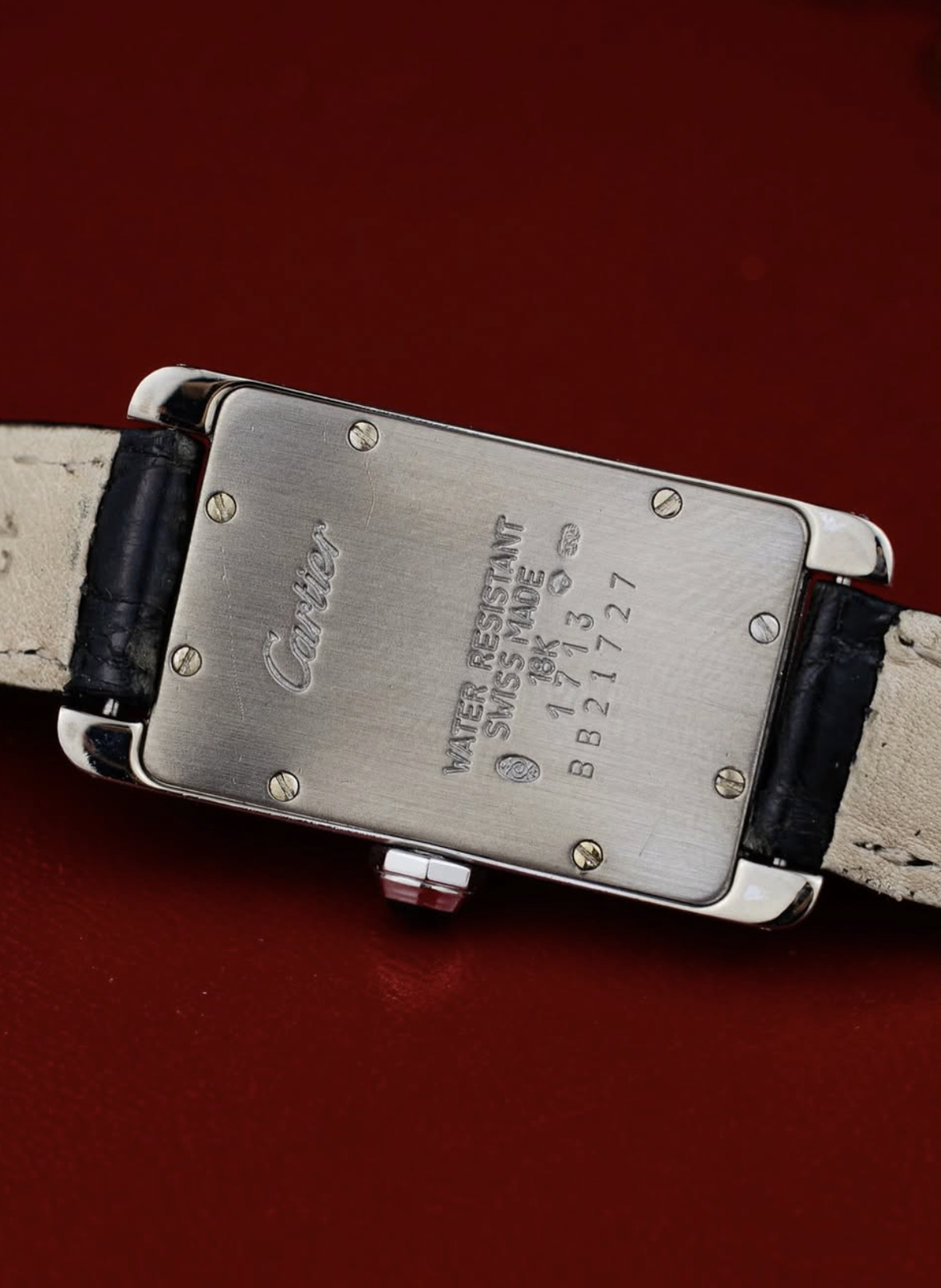
- Cartier
- The signature, in script.
- WATER RESISTANT · SWISS MADE
- Construction and origin.
- 18K
- The metal. On a white gold case the color tells you nothing; the mark does.
- 1713
- The reference. Four digits here. This is the number the archive is indexed by.
- BB21727
- The serial: two letters and five digits. Yours alone. Not the number to search.
- Small stamped symbols
- Hallmarks: the assay marks for the metal and a maker’s mark. Leave them to the dealer.
Photograph by @timecatcherswatch. Click the photograph for the reference page.

- Cartier
- The signature.
- Quartz
- The movement type. Older backs say this; later ones often do not.
- 18K · SWISS MADE
- Metal and origin.
- 887904
- The reference: six digits on this generation. Still the number to search.
- 001592
- The serial, directly beneath. Six digits, leading zeros kept.
Photograph by @barbun_watches. Click the photograph for the reference page.
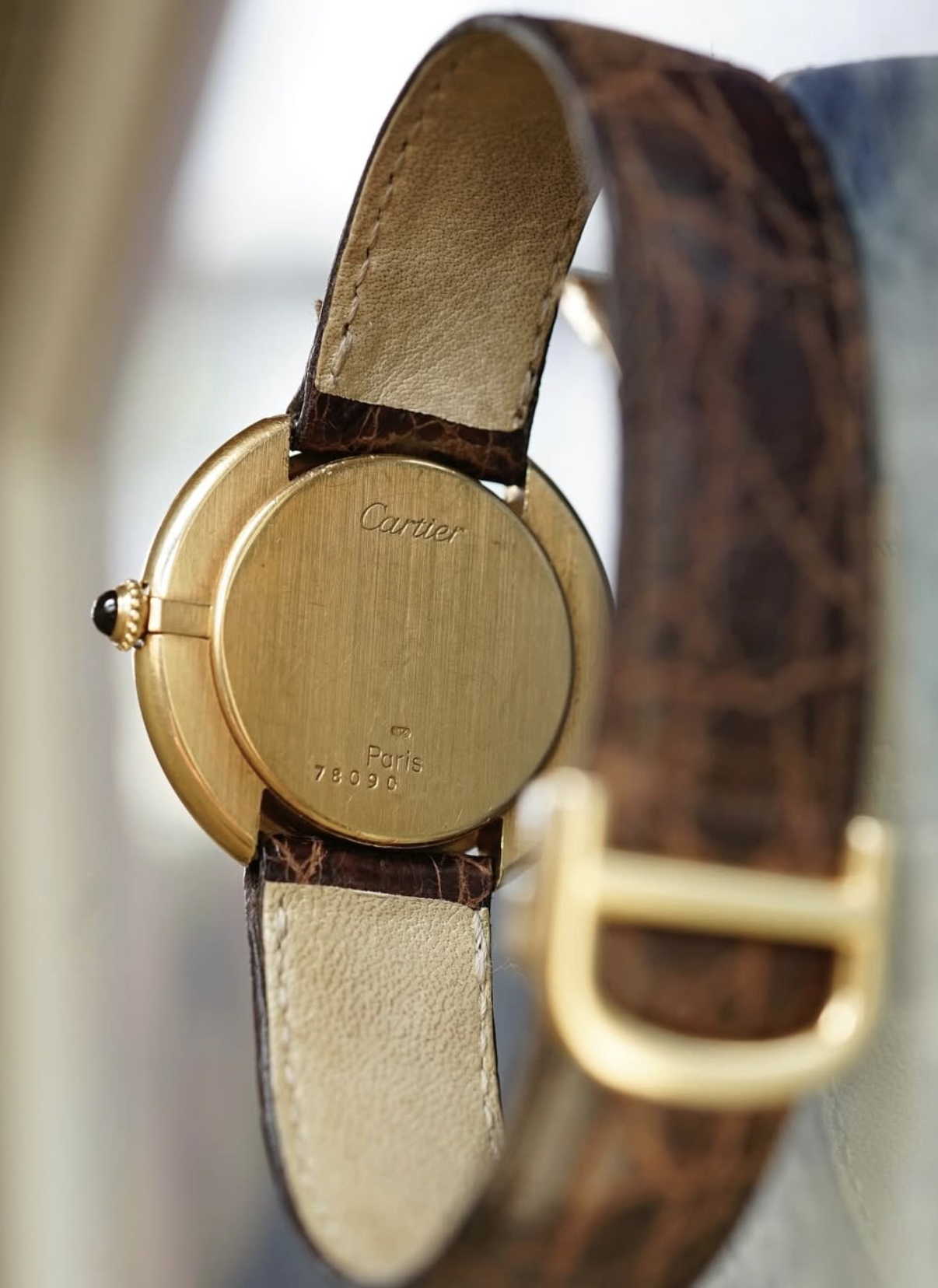
- Cartier · Paris
- The Paris-era signature. Watches cased in this period often carry the city.
- 78090
- The reference: five digits, with the Paris mark beside it.
- A stamped symbol
- A hallmark. On Paris pieces the serial is sometimes small, elsewhere on the case, or inside; the reference is what you need.
Photograph by @arthurcollecting. Click the photograph for the reference page.
Photographing the engraving
Your phone is enough. The light is what matters.
- 01Do not open the case, and do not polish or clean the back. Worn engraving is still engraving; polishing removes it for good and costs you at a sale.
- 02Daylight from a window, no flash. Lay the watch on something dark and tilt it until the engraving catches the light at a low angle; a shallow raking light makes faint lines readable.
- 03Fill the frame with the back and hold still. Take three or four and keep the sharpest. If the numbers are faint, breathing on the metal for a second before the shot can lift them.
- 04Write down every line exactly as it reads, including leading zeros and letters. Then search the longest numbers first. The reference matches a page; the serial matches nothing.
What the back cannot tell you
Whether it is genuine. Copies carry references, serials and hallmarks too. A back that reads correctly is a starting point, not a conclusion; a dealer who handles the watch at inspection is the one who attests to it on the record.
The year. Cartier serials do not reliably encode a date, whatever a lookup site says. The archive places a watch in its production run by the reference and its known ranges, and says so on the reference page.
What it is worth. The reference page shows recent sales of the reference with their sources. That is context for your watch, not a valuation of it.
If nothing matches
Create the record anyway and type every line from the back into the form. A number the archive does not know yet is how the archive grows: it goes to review, and you hear back within two business days with the match or with what could not be established and why. Nothing is shown to a dealer in the meantime.