How to read a vintage Cartier.
General guidance that applies across the archive. For what is documented about one watch, open its reference page.
Reading the Case Back
Each engraved line says something different. Only one is the number to search.
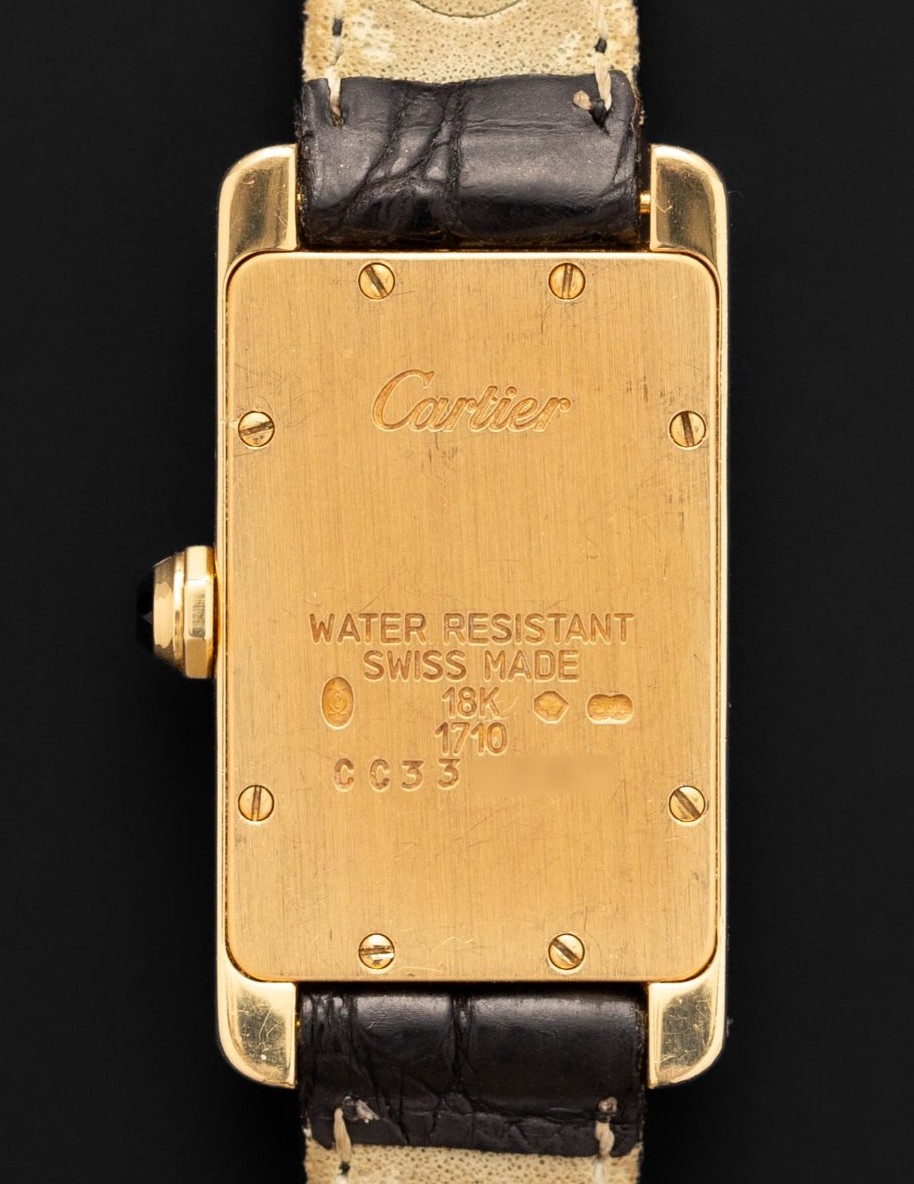
- What it is
- Cartier in script. Paris-cased watches of the 1970s and 1980s may add Paris. Les Must pieces say must de Cartier.
- On this watch
- Cartier alone, with no city.
- What it tells you
- Who signed it, and sometimes where it was cased. Not the model. Copies carry a signature too.
- What it is
- Short lines such as Swiss Made, Water Resistant, Quartz or Automatique.
- On this watch
- WATER RESISTANT over SWISS MADE.
- What it tells you
- Where it was made and how it is built. None of it changes which reference page you need.
- What it is
- 18K or 750 is 18-karat gold. 925 or Argent is sterling silver. Plaqué is gold plating. Steel says Acier, Stainless Steel, or nothing.
- On this watch
- 18K, on a yellow gold case.
- What it tells you
- What the case is made of. Argent with a gold color is vermeil: silver under gold.
- What it is
- The number that names the model. Every watch of that model carries it. Four digits (1710), five (78086) or six (887904), depending on the generation.
- On this watch
- 1710. Search it and you land on the Tank Américaine Ref. 1710 page.
- What it tells you
- Exactly which watch you have. Boutique codes such as W51008Q3 are usually not on the case; the archive lists those too.
- Open the Ref. 1710 page
- What it is
- The number that belongs to this one watch, usually just beneath the reference. Six digits on many 1980s and 1990s pieces; two letters and digits later.
- On this watch
- CC33, then digits that are blurred in this photo. Sellers often hide part of a serial when a watch is shown publicly, because the number belongs to one watch alone. On the watch itself it is complete.
- What it tells you
- Which individual watch this is. It matches no page, so do not search it. It does not give the year either: papers, a London date letter or the reference’s production years do.
- What it is
- Small stamped symbols, often in a lozenge or an oval: an assay mark for the metal and the case maker’s mark.
- On this watch
- Three small marks on the 18K line: one to its left and two to its right.
- What it tells you
- Where the metal was tested and who made the case. A sharp photo in daylight is enough. Do not open, polish or clean the case.
- What each mark means
The numbers, era by era
- Paris, 1910s to 1960sA case number, no referenceBefore references, a Paris case carries its own number, sometimes struck on more than one part, and the movement has another. Catalogs print the two side by side.19··· and 23···
- London, 1920s to 1980sHand-stamped numbers and a date letterLondon cases carry hand-stamped numbers, often repeated inside the back beside the JC punch, and a full British hallmark set whose date letter gives the year of assay. A gold deployant clasp has its own hallmarks and its own number, which does not match the case.67·· · 96··
- Paris, 1970s to 1980sThe reference runs into the serialOne long number with the reference first: a Tank Louis 78086 or a Vendôme 78094 followed by four digits. Catalogs split it differently, and some print only the last digits as the case number.78086····
- Les Must, 1970s to 1980sSix digits over six digitsThe six-digit reference sits on top and the serial beneath it, leading zeros kept.887904 / 00····
- Swiss production, 1990s onFour digits, then lettersA four-digit reference with a serial of digits and two letters, on the same line or the next. The letters come first on some models and last on others, and catalogs do not always print them the way the case does.26····CD 1725
- Modern catalog codesW-numbers live on the papersCodes such as W51002Q3 are the boutique catalog numbers. They are on the guarantee and the box, rarely on the case.W51002Q3
What the back cannot tell you: whether the watch is right (copies carry references, serials and hallmarks too), the year (the digits do not reliably give it), or the value.
Cartier Hallmarks
Small struck marks say where a case was tested, what it is made of, and who answered for it.
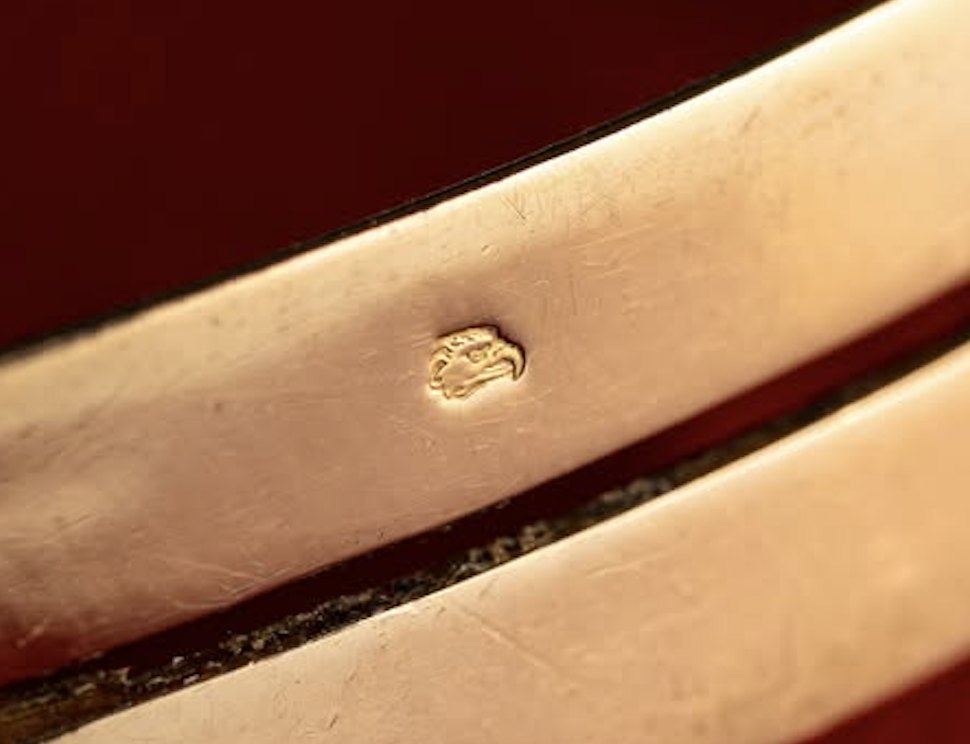
Assay mark
Struck by a state assay office after testing the metal.
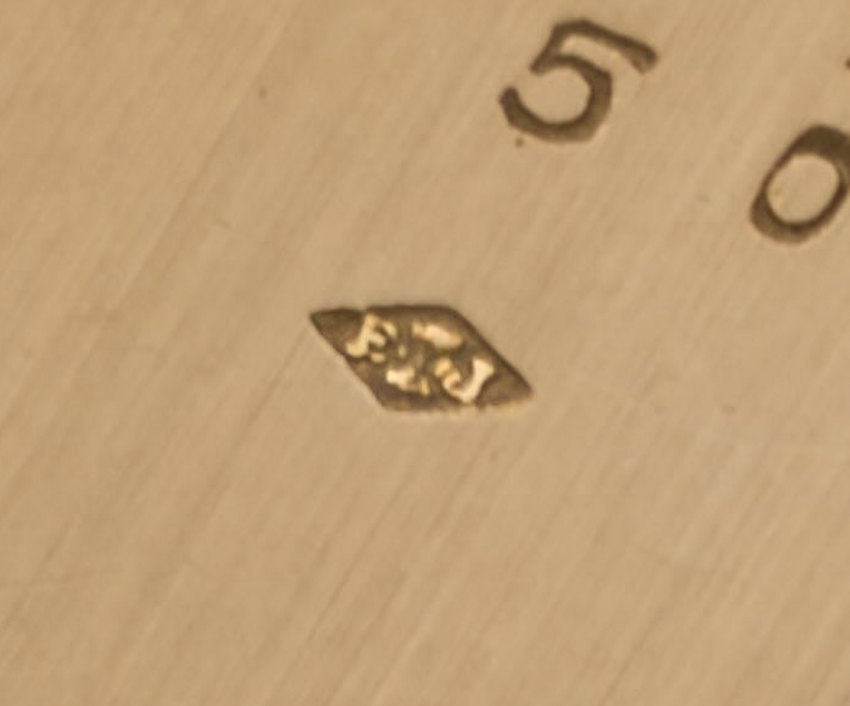
Maker’s mark
The workshop that made or sent in the case, often not Cartier.
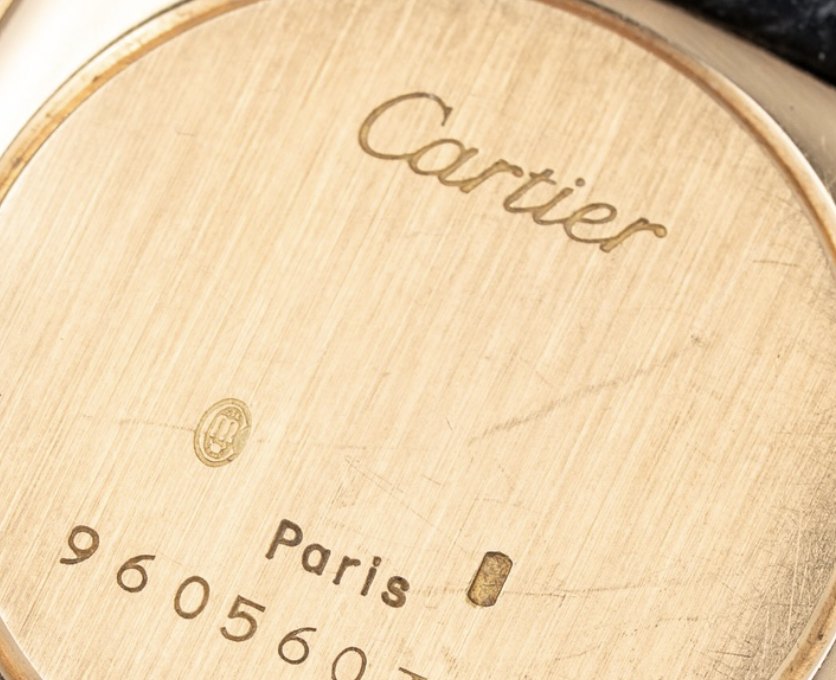
Cartier’s signature
Engraved on the case back, later with a reference and a serial.
Cartier Paris
Dog's head
France's mark for platinum. Found on Cartier platinum watches such as the Baignoire, and on their clasps.
Where to look: case back, clasp.
Eagle's head
France's mark for 18k gold. The most common state mark on a Paris-cased Cartier, on the case and often the clasp too.
Where to look: case back, lugs, buckle.
Some sources say it only replaced the horse's head in the provinces from 1919, so on a pre-1919 piece it may point to Paris.
EJ (Edmond Jaeger)
Edmond Jaeger's maker's mark: an E and a J either side of an hourglass, inside a lozenge. The best documented case maker's mark on Cartier Paris watches, from about 1910 to the 1970s.
Where to look: case back, deployant clasp.
Owl
Gold of foreign or uncertain origin, tested by French assayers. On a Cartier it usually means the watch entered or was sold in France. Two owls: it came in twice.
Where to look: outside of the case back.
Two owls can mean the watch was assayed in France on two separate occasions.
SA with a C between two crescents (Société Anonyme Cartier)
Cartier's own maker's mark as a société anonyme: an S and an A either side of a C set between two crescents, inside a lozenge. It marks a piece Cartier answered for as the maker, where an outside workshop's mark (EJ for Edmond Jaeger) would otherwise stand. Christie's reads it on Swiss-hallmarked Cartier cases and clasps of the 1990s.
Where to look: case back, clasp.
The two crescents face each other around the C, so worn or small strikes read as a C inside a circle, between S and A. Christie's describes it as 'S 2 interlaced crescents A'. On many Swiss-made Cartier cases from the 1980s on, the same S, C and A sit in an oval rather than a lozenge.
Cartier London
Date letter
One letter a year in a shield; the letter's style and shield shape set the cycle. Before 1975 London changed letters each May, so catalogs write a span such as 1963–64. A clasp can carry a different year from its case.
Where to look: inside the case back, clasp.
A pre-1975 London letter spans two calendar years, which is why catalogs write '1963-64'.
Crown and 18
A crown beside the figure 18 marks British 18k gold. From 1975 the figure became 750, still beside a crown.
Where to look: inside the case back, clasp.
Imported (Swiss) cases never got the crown. They show 18 with .75 and the London Leo instead.
Crown and 750
From January 1975, 18 carat gold is marked 750 (parts per thousand). UK-made pieces kept a crown beside it, which was compulsory until 1998 and optional from 1999.
Where to look: inside the case back, on the clasp or buckle.
Imported pieces from 1975 to 1998 show 750 without the crown, next to the London Leo.
9 carat (9 and .375; 375 from 1975)
British 9 carat gold. Before 1975 the mark is the carat and its decimal, 9 and .375, with no crown. From 2 January 1975 it is the figures 375, with a crown beside it on UK-made pieces.
Where to look: inside the case back.
9 carat is rare on Cartier London watches. Sotheby's calls the 9ct case of a 1950-51 Tank an extremely unusual choice for Cartier, so check the buckle too: on that watch it is 18k.
London import mark (sign of Leo)
Swiss-made Cartier watches assayed in London carry the sign of Leo instead of the leopard's head, no crown, and the fineness as 18 and .75 (750 from 1975).
Where to look: inside the case back, buckle.
Leo was struck upside down until 1950. One source says it stayed inverted on gold until December 1974.
JC
Cartier London's own mark, struck beside the London hallmarks. Its cases were made by Wright & Davies, which left no mark of its own.
Where to look: inside the case back, clasp.
Auction catalogs alternately say 'Jacques Cartier' and 'Jean-Jacques Cartier' for the same JC punch.
Swiss cases
Helvetia head
Switzerland's mark for 18k gold on watch cases: a woman's head in a shield. In 1995 a single mark, the St. Bernard's head, replaced it.
Where to look: inside the case back.
From 1914 Swiss law covered watch cases in 750 gold with this mark; 1995 end date comes from secondary sources, not the official page.
Swiss responsibility mark (maker's mark)
Swiss law requires a registered responsibility mark, the symbol of the firm that answers for the piece, beside the fineness before a case can be hallmarked. On Swiss-hallmarked Cartier cases and clasps of the 1990s Christie's reads it as the lozenge of Société Anonyme Cartier (S A with two interlaced crescents). Case makers could instead use a numbered collective mark.
Where to look: inside the case back, clasp.
Lots usually say only 'maker's mark'. The lozenge shape and the S A Cartier mark follow French convention; see the SA Cartier mark.
Later, New York and international
Common Control Mark (CCM)
The Vienna Convention mark: a pair of scales with the fineness in thousandths inside a frame whose shape shows the metal. It is struck alongside a national assay mark, a responsibility mark and a fineness mark.
Where to look: inside the case back.
CARTIER PARIS signature
CARTIER PARIS engraved on the case back with the reference and a serial number. The reference is the number the archive is indexed by.
Where to look: outside of the case back.
Serial date reading is approximate per the dealer guides.
Before You Buy
Six short reads. Each opens beside the page.
The Secret Signature
A microscopic 'CARTIER' hidden within one of the Roman numerals, which catalogs date to the late 1970s. Look for it on Roman numeral dials made after that.
Case Back Hallmarks
A Cartier case carries the Cartier signature, a reference and serial number on later pieces, and small struck marks for the metal and the case maker. Which marks appear depends on where the case was made: an eagle's head on Paris gold, JC and a date letter on London cases, the Helvetia head on Swiss 18k before 1995. The hallmarks guide shows what each one means.
Movement Sourcing
Cartier sourced movements from various Swiss manufacturers throughout history, including Jaeger-LeCoultre, Frédéric Piguet, ETA, and in-house production. Knowing the correct caliber for a specific reference is essential for identifying the watch and establishing provenance.
Crown Sapphire Cabochon
The blue sapphire (or spinel on less precious models) cabochon crown is a Cartier signature. Original crowns show consistent color saturation and are set flush with the crown body. Replacements often show misalignment or incorrect stone dimensions that reveal themselves under magnification.
Bracelet and Clasp Markings
Cartier bracelets carry their own reference markings and the deployment clasp should bear the Cartier name and logo. Aftermarket bracelets are extremely common on vintage pieces, so checking that the clasp is original and that reference numbers match is crucial to the overall picture.
Dial Aging and Patina
Vintage Cartier dials develop characteristic aging: cream dials warm to ivory, lacquer dials may develop fine crazing, and applied indices can show legible wear patterns. Understanding acceptable versus concerning dial aging is key to valuing a vintage piece accurately.
Common Questions
What does the eagle’s head stamp on my Cartier mean?
- It is France’s state mark for 18k gold, struck after the metal was tested. On a Cartier it usually means the case was assayed in France, most often for Cartier Paris.
Why does my Cartier have an owl stamp?
- Since 1893 France has struck the owl on gold of foreign or uncertain origin after testing it. On a Cartier it usually means the watch entered or was sold in France. Two owls mean it came in twice.
What does JC mean on a Cartier watch?
- JC is Cartier London’s sponsor’s mark, struck beside the London hallmarks on cases and clasps. Its cases were made by Wright & Davies, which left no mark of its own.
Can hallmarks tell me when my watch was made?
- A London date letter names the year of assay; before 1975 each letter runs May to May, so catalogs give two years. French and Swiss marks narrow the era to a span of decades, and on later pieces the reference and serial number on the case back do the rest.
Does a squirrel mean my Cartier is 18k?
- No. The squirrel is the Swiss mark for 14k gold. Swiss 18k gold carries the Helvetia head before 1995 and the St. Bernard’s head after.
My watch has no French marks. Is that a problem?
- Not on its own. London, New York and Swiss cases each carry their own marks, and steel pieces carry no assay mark at all.
How Archiva Works
Archiva describes and documents a watch. It does not guarantee one. These three rules decide what a page is allowed to say.
- 01
How a reference is documented
Every fact on a reference page comes from auction and dealer records of that exact reference.
A fact counts as settled when three independent records say the same thing. With fewer, or where records disagree, the page says so.
- 02
How values are worked out
Estimates use public sale results that name the reference, from the last 36 months. A reference with fewer than three sales in that time may reach back another 24.
A sale far above or below the rest is listed but not counted. It is an estimate from public results, not an appraisal.
- 03
What counts as vintage
The archive covers watches 25 years old or more, counted from the current year.
Newer references are outside its scope for now, so a modern Cartier may not have a page.
Seeing something on your watch that no guide explains?
Send us a photo