Cartier · Cartier Baignoire

Baignoire, Cartier London, 18k Gold

London Baignoirec. 1964–1974

The London Baignoire is the oval Cartier Baignoire made for Cartier London c. 1964–1974: 18k gold, in sizes from 25 × 19 mm to 36 × 23 mm, hand-wound on a LeCoultre Co. Cal. 840, with London hallmarks and the JC sponsor's mark.

Have this watch?

We’re opening a small panel of specialist dealers soon. Leave your email and we’ll write once, when they’re ready to bid on your watch. Nothing else.

Reference photography unavailable.

Want to sponsor this reference with your studio photography? Become a sponsor

Specifications

Reference
London Baignoire
Made for Cartier London, London hallmarks, manual wind
Year
c. 1964–1974
Monaco Legend catalogs one circa 1964; London hallmark date letters on documented examples run from l (1966–67) to s (1973–74)
Movement
Manual
LeCoultre Co. Cal. 840 or K840, 17 jewels; a Cal. 845 is also documented
Case
25 × 19 mm to 36 × 23 mm, 18k Yellow Gold (white gold rare)
Dial
Cream, silvered or white
Black Roman numerals, often elongated toward the edge; some dials are signed Cartier London; one white gold example has a black dial
Hands
Blued steel
Baton or sword-shaped
Crystal
Glass
Type not stated in the catalogs consulted
Strap
Leather
Fitted under hooded lugs, with an 18k gold Cartier deployant clasp hallmarked and numbered to match the case; some examples are on a Cartier London gold bracelet

Visual Description

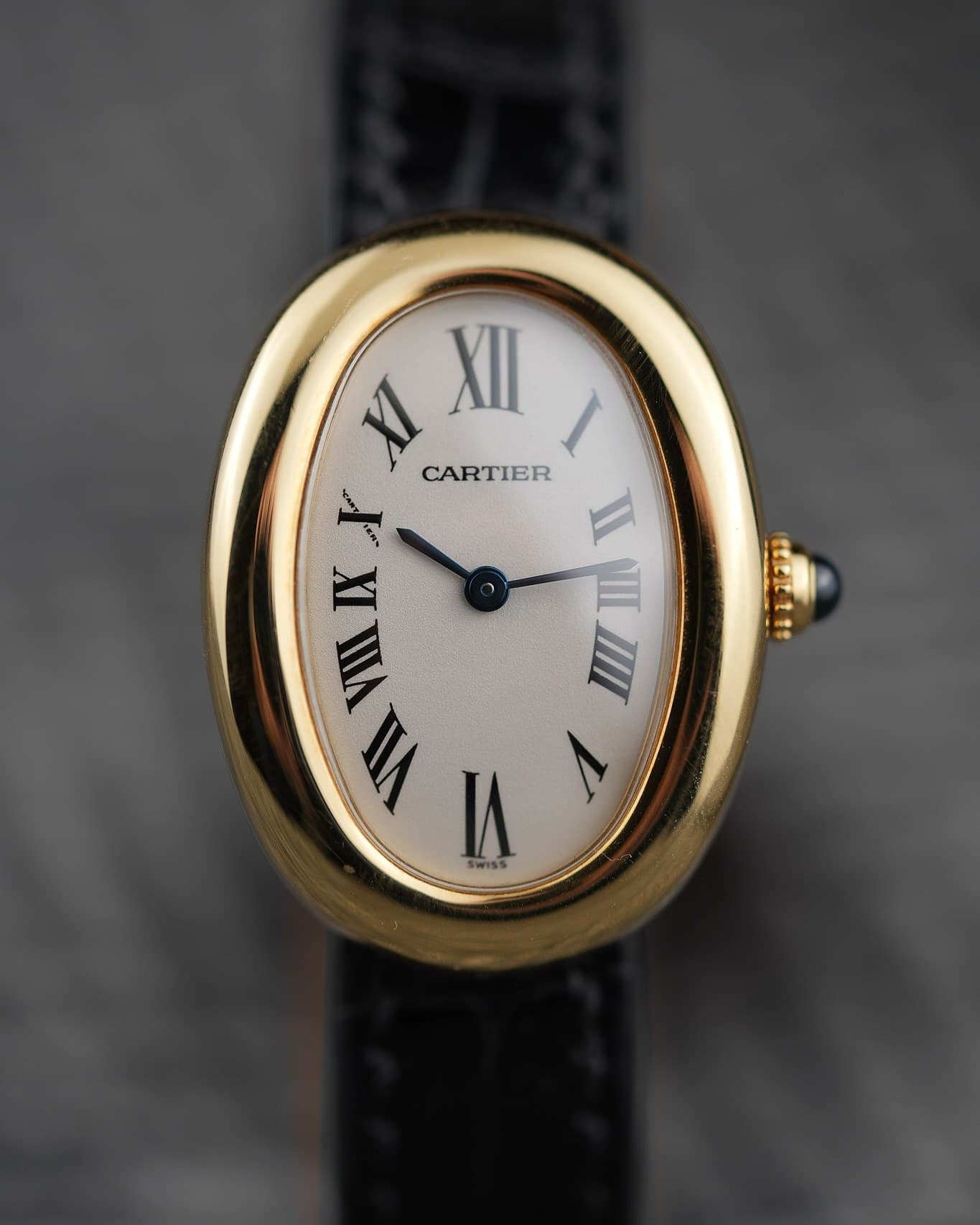
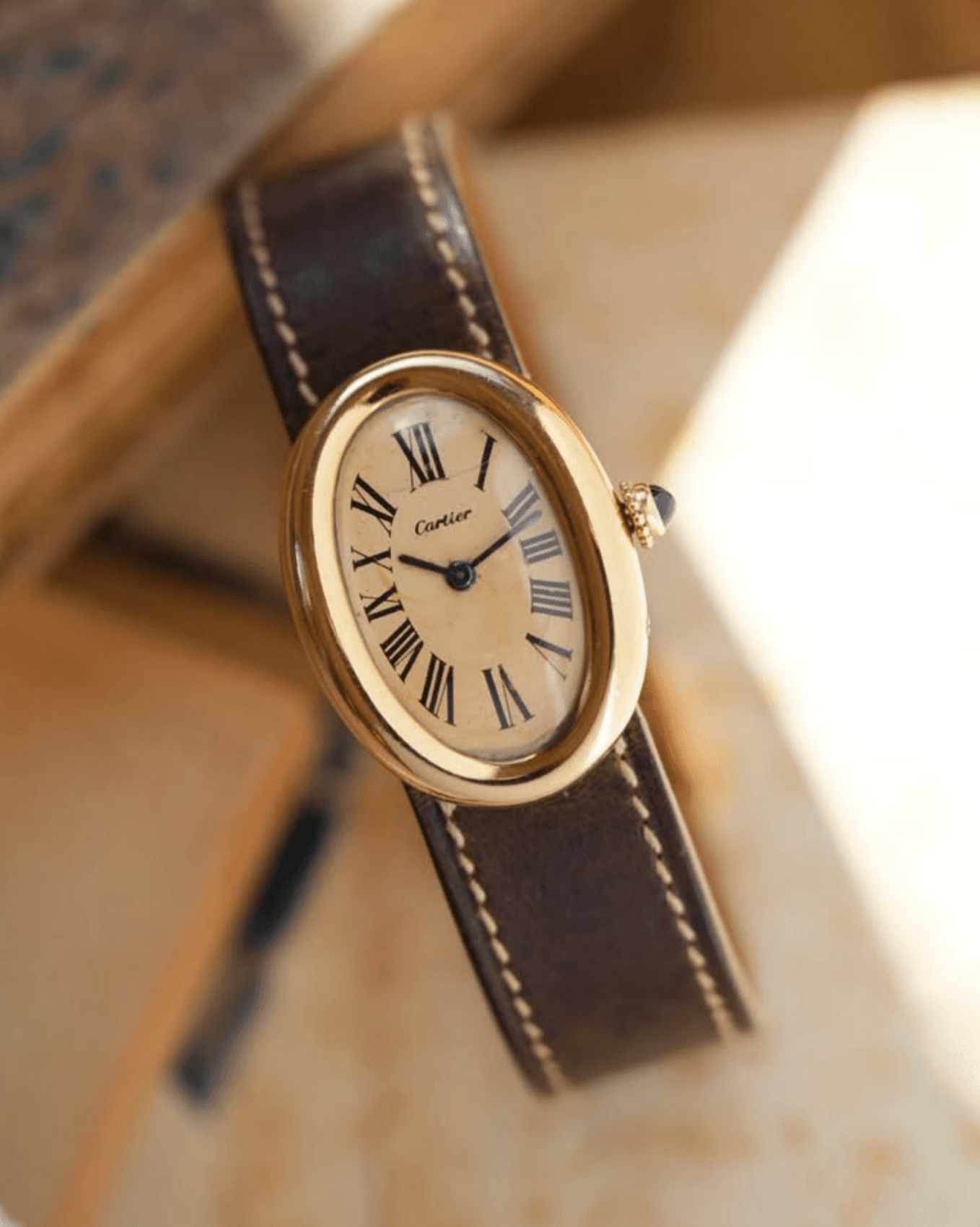
The London Baignoire is the familiar Cartier oval: a smooth 18k gold case curving away from the dial on every side, with the strap tucked under hooded lugs so nothing interrupts the outline. Most examples are yellow gold. Dials are cream, silvered or white, printed with black Roman numerals that are often stretched toward the edge of the oval, and the hands are blued steel. On some examples, the large size in particular, the dial is signed Cartier London.

It comes in three documented sizes. The small size, about 25 × 19 mm, is the one most often seen. The regular size, about 31.5 × 23 mm, matches the footprint of the Paris Ref. 7672. The large size, about 35–36 × 23 mm, pushes the ends of the oval outward and lets the numerals run long. Watches are fitted to leather straps with an 18k gold Cartier deployant clasp, hallmarked and numbered to match the case, and a few are on Cartier London gold bracelets.

Reference Significance

The London Baignoire is identified by where it was sold rather than by a number. English hallmarks with a date letter, the JC sponsor's mark of Jacques Cartier and a London stock number repeated on the clasp are what separate it from the Paris Baignoire, and they let an owner date the watch to the year.

Cartier London in this period had a reputation for invention. Sotheby's calls the London branch under Jacques Cartier the most subversive and mold-breaking of the three houses, and Monaco Legend notes that the London workshop worked with a degree of creative independence. That independence produced the Crash and the Baignoire Allongée. The London Baignoire is the same workshop's version of the classic oval, and its large size shows the same appetite for stretching a familiar shape.

Historical Context

Documented examples run from about 1964, the date Monaco Legend gives one example, to 1973–74, the date letter on a large example sold by Sotheby's. Fellows notes that a London hallmark indicates the watch was retailed through Cartier's Bond Street boutique. Movements came from LeCoultre and are signed LeCoultre Co.; the Cal. 840 and K840 are the ones most often recorded, and Sotheby's lists a Cal. 845 in a white gold example.

Not every London Baignoire was cased in London. Watches of Knightsbridge documents examples with London import marks, assayed on arrival in Britain, alongside those with domestic hallmarks. Both were sold by Cartier London, and both carry the JC sponsor's mark. The large size was made in very small numbers: Watches of Knightsbridge describes batches of three at a time and fewer than six examples known.

What to Look For

Start with the marks inside the case back: the 18k standard mark, the London date letter, the JC sponsor's mark and a stock number. The same number should appear on the gold deployant clasp, as Sotheby's and Watches of Knightsbridge both note on their examples. A clasp without matching numbers may be a later replacement, which affects value on a watch where the clasp is part of the original set.

Open the case to see the movement, which should be a manual-wind LeCoultre caliber such as the Cal. 840 or K840. Check the date letter yourself rather than relying on a listing's year, since letters straddle two calendar years. On the dial, look for crisp, even printing of the Roman numerals; elongated numerals are correct for many London examples and are not a sign of a replacement dial. Polishing is the main risk to the case, as it softens the curve of the oval and can wear down the hallmarks.
Known Variants

Documented dial, case, and bracelet variations of London Baignoire.

Small, about 25 × 19 mm

The most common London size (Loupe This). 18k yellow gold, cream dial with exaggerated Roman numerals, LeCoultre Co. Cal. 840, on a deployant clasp or a gold bracelet.

c. 1966–1972The size most often offered by dealers

Regular, about 31.5 × 23 mm

The same proportions as the Paris Ref. 7672 but with London hallmarks and the JC mark. Sotheby's sold one of about 1969 with matching serials on case and clasp.

c. 1967–1969Uncommon

Large, about 35–36 × 23 mm

Ends stretched outward and Roman numerals elongated to the edge, dial signed Cartier London, LeCoultre Co. Cal. K840. Watches of Knightsbridge says they were made in batches of three and that fewer than six are known.

c. 1972–1974Very rare

White Gold, Black Dial

A regular-size white gold example hallmarked London 1967, with a black dial, Cal. 845 and a pink gold clasp, sold by Sotheby's as the Black Baignoire.

1967Exceptionally rare

London Import Marks

Some examples carry London import marks rather than domestic hallmarks, meaning the case was assayed on arrival in Britain rather than made there. Watches of Knightsbridge documents a 1970 example on a gold bracelet.

c. 1970–1972Found alongside domestically hallmarked examples

How to tell it apart

What separates the London Baignoire from its neighbors, and what to check before you buy or sell one.

What is a London Baignoire?

An oval Cartier Baignoire sold by Cartier London in the 1960s and early 1970s, recognized by its English hallmarks rather than a reference number. Documented examples are 18k gold, hand-wound on a LeCoultre Co. caliber, with the JC sponsor's mark of Jacques Cartier inside the case back and a gold deployant clasp numbered to match the case.

Does the London Baignoire have a reference number?

No. None of the auction houses or dealers we consulted gives one. Cases carry Cartier London stock numbers, usually four or five digits, matched on the clasp, and Loupe This lists the reference as N/A. A number on a London Baignoire identifies the individual watch, not the model.

How do I tell a London Baignoire from a Paris Baignoire Ref. 7672?

Read the hallmarks. A London example carries English marks for 18k gold with a date letter, the JC sponsor's mark and a London stock number, often repeated on the clasp. The Paris Ref. 7672 is about 31 × 23 mm with a case back engraved Cartier Paris and French marks. The regular London size is nearly the same footprint, so the marks, not the shape, settle it.

How is it different from the Baignoire Allongée?

Proportion. The Allongée, also made for Cartier London in the late 1960s, stretches to about 52 × 22 mm, more than twice as long as it is wide. Even the large London Baignoire stops at about 36 × 23 mm, with its ends pushed outward rather than drawn into a ribbon.

How do I date a London Baignoire?

From the London date letter in the hallmark. The London date letter changed partway through each year, so each letter spans two calendar years: l is 1966–67, n is 1968–69 and s is 1973–74. Some listings give a single year one earlier than the cycle, so check the letter yourself.

Which size is my London Baignoire?

Measure it. Small examples are about 25 × 19 mm and are the most common; regular examples are about 31.5 × 23 mm; the rare large size is about 35–36 × 23 mm with ends that flare outward and Roman numerals reaching the edge of the dial.