Visual Description
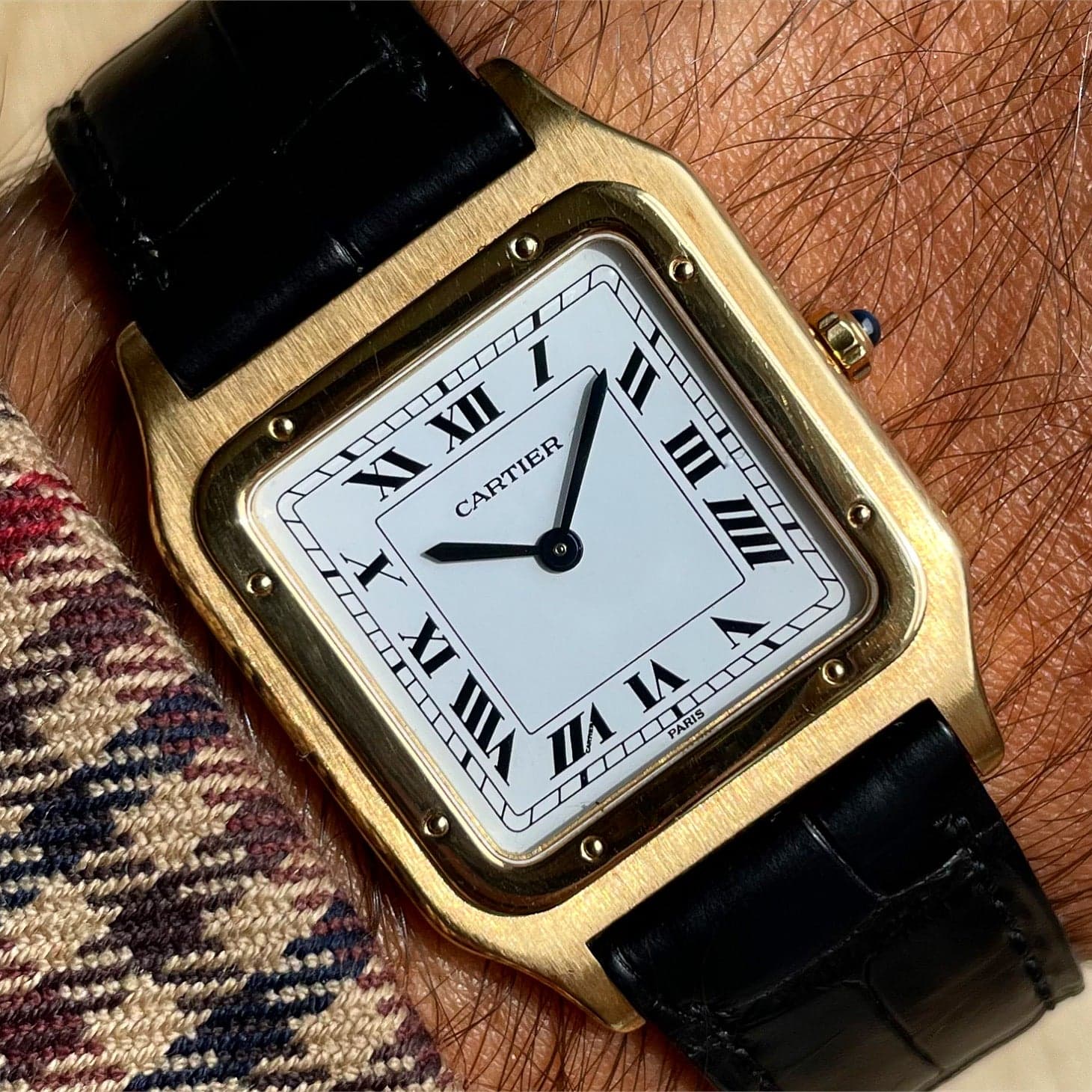
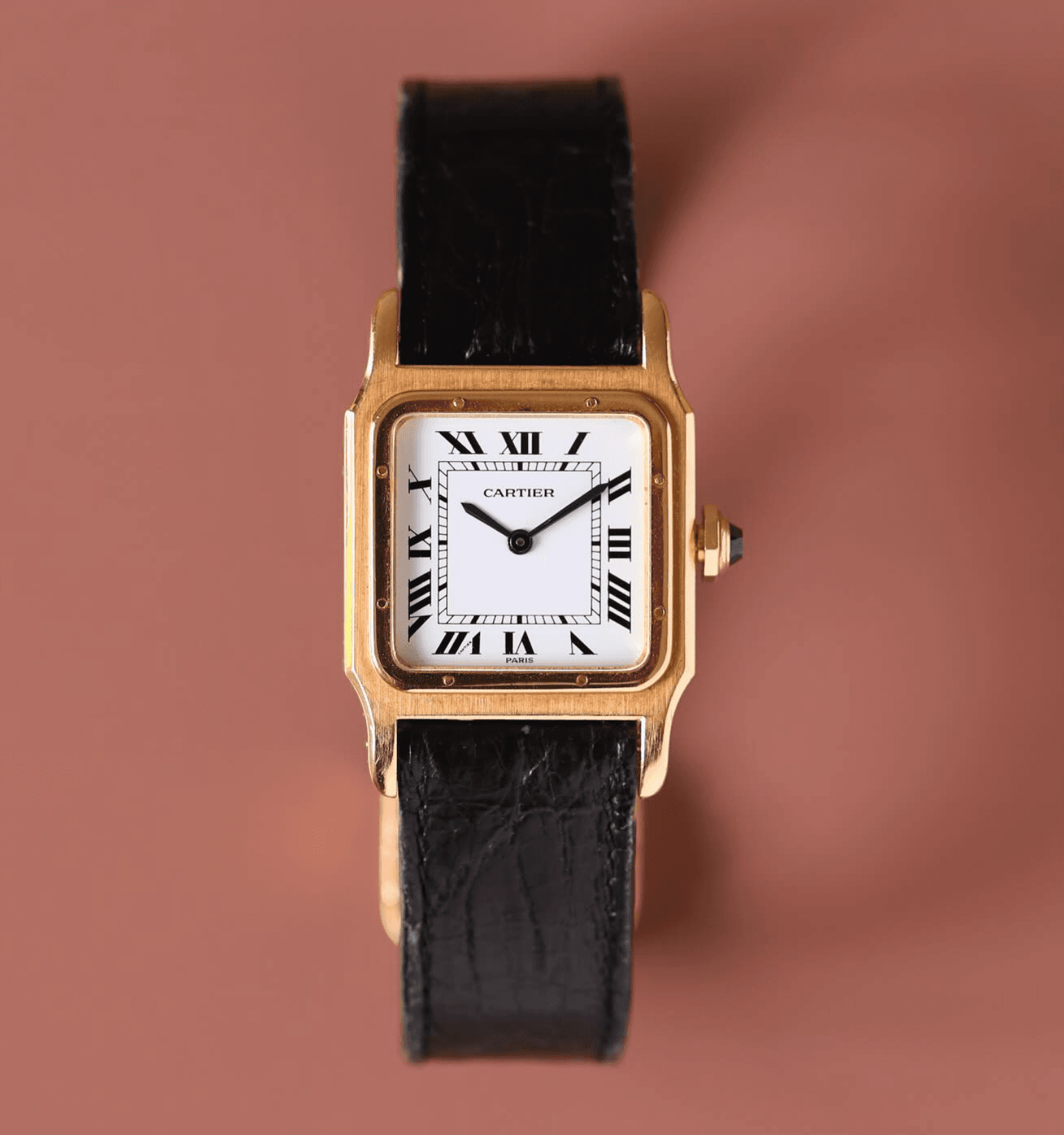
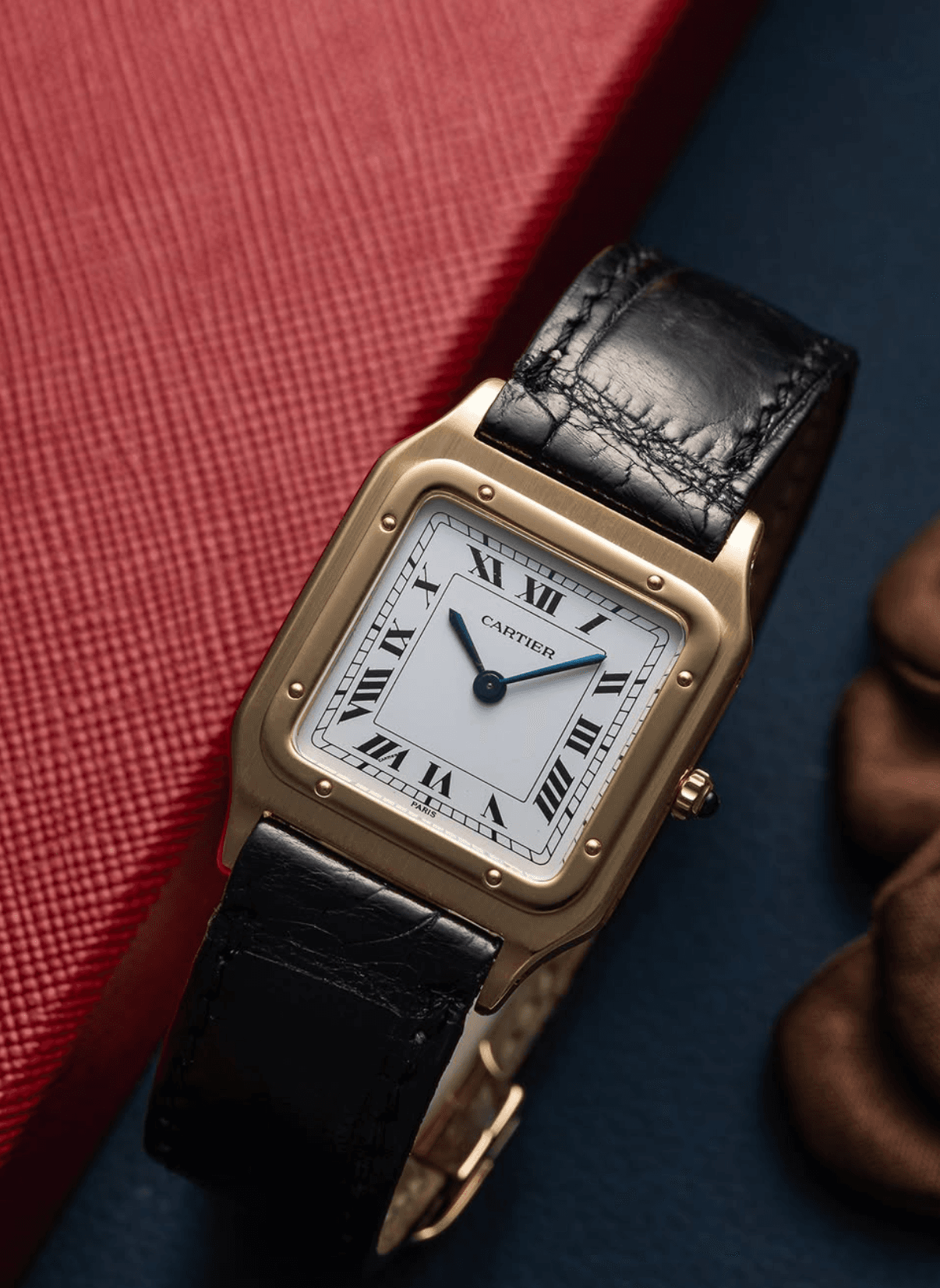
The 821054 is the Santos Dumont at its flattest and plainest in outline: a 27 × 36 mm rectangle of 18k yellow gold, worn on a leather strap. What separates it from the better-known white-dial 96054 is the dial, an engine-turned silver guilloché that dealers call flinqué, printed with black Roman numerals and carrying the hidden Cartier signature at VII. Blued hands and an octagonal crown set with a sapphire cabochon complete the front.
The case is thin enough that dealers sell it as Extra-Plate or ultra-thin, which follows from the movement inside. Watches have come on leather straps with an 18k yellow gold Cartier deployant clasp, as on the Antiquorum and Bulang & Sons examples, or with a gold Cartier tang buckle, as on Menta's.
Reference Significance
The 821054 is the 1990s guilloché-dial version of the large ultra-thin Santos Dumont. It keeps the case size and the hand-wound Cal. 21 of the 96054 but trades the plain white dial for engine-turned silver, which gives a dressier, more textured face.
Its numbering is a small puzzle worth understanding. Bulang & Sons calls it Ref. 8210, other dealers call it 821054, and the case numbers read 8210, then 54, then a serial. The same structure appears on the earlier 9605 family, where 96053 is the small size and 96054 the large, so an owner reading 821054 on the case back has the large size of the 8210 family.
Historical Context
Dated examples cluster in the mid to late 1990s. Antiquorum catalogs one circa 1990s, a Bulang & Sons example has a warranty paper recording a sale in Italy in 1996, and Amsterdam Watch Company records one from 1997. Antiquorum sold an example in Hong Kong in May 2022 for HKD 45,000, and Fellows offered one in its July 2016 Watch Sale.
The movement links it to the Santos Dumont's ultra-thin tradition. The Frédéric Piguet Cal. 21 is an ultra-thin hand-wound movement, and Cartier used it across its Extra Plate references of the 1970s and 1980s. The 821054 carried that movement into the 1990s, just before Cartier's Collection Privée line brought the Santos Dumont back in platinum and gold with the Cal. 021MC.
What to Look For
Read the case number first: it should begin 821054 for the large size. A number beginning 96054 is the white-dial predecessor, and one beginning 821053 is the smaller 23 mm model. Measure the case if the listing is unclear, since Antiquorum cataloged one 821054 at 31 × 22 mm, a figure that matches no other source.
The guilloché should be sharp and evenly cut across the whole dial, with the Roman numerals printed cleanly over it; a refinished guilloché dial loses depth at the edges. The movement should be the hand-wound Cal. 21. Because the case is so thin, polishing quickly wears the edges round, so look for crisp corners at the lugs. Papers and the original gold deployant clasp add to value on a reference that changes hands infrequently.