01DIAL
The Secret Signature
Introduced 1977
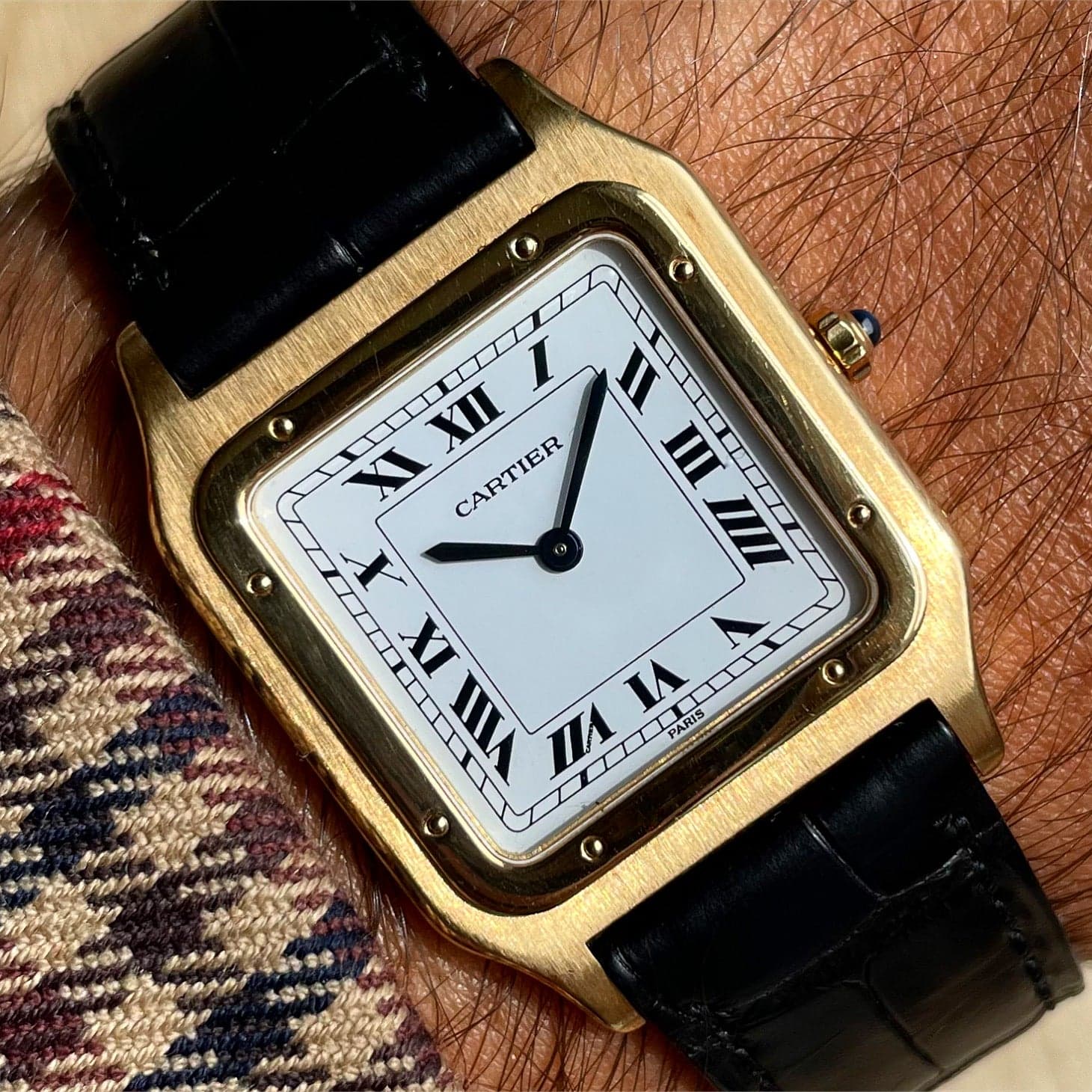
A microscopic 'CARTIER' hidden within the Roman numerals — present on every genuine post-1977 dial.
Cartier
The world's first purpose-built wristwatch, created for an aviator who refused to take his hands off the controls.
The Santos Dumont is not merely one of the first wristwatches — it is the first wristwatch designed for a specific purpose and a specific person. In 1904, Louis Cartier created a timepiece for his friend Alberto Santos-Dumont, the Brazilian aviator who needed to check the time while piloting his airships over Paris without releasing the controls. The solution was revolutionary in its simplicity: strap a watch to the wrist.
What made the Santos distinctive was not just its wearability but its design conviction. Where pocket watches adapted for wrist use looked like exactly that — round cases with awkward lugs — the Santos was conceived as a wrist-native object from the start. The square case with exposed screws on the bezel, the integrated strap attachment, the legible dial with Roman numerals: every element was drawn for the wrist, not repurposed from the pocket.
Cartier began commercial production in 1911, making the Santos the first men's wristwatch offered to the public. It remained in production in various forms through the twentieth century, with the "Santos Dumont" designation eventually distinguishing the slim, dressy interpretation from sportier Santos variants.
The Santos Dumont as collectors know it today begins in the 1970s, when Cartier reinterpreted the original design with a series of faithful reproductions in 18k gold. The Ref. 78097 — a manual-wind piece with Paris hallmarks and the Cal. 78-1 movement — established the template: a slim, elegant dress watch that honored the 1904 proportions while meeting contemporary expectations for finishing and reliability.
Through the 1970s and 1980s, the Santos Dumont became a canvas for Cartier's ultra-thin ambitions. The Ref. 96054, powered by the legendary Frédéric Piguet Cal. 21, measured just 4.5 mm thick — a remarkable achievement that positioned the Santos Dumont alongside the thinnest dress watches from any maison. Production was limited to approximately 1,600 pieces, making these ultra-thin references among the most sought-after vintage Cartiers.
The pinnacle arrived in 1994 with the Collection Privée Cartier Paris (CPCP) line, which revisited the Santos Dumont with the Cal. 021MC — Cartier's own evolution of the Piguet Cal. 21. CPCP references like the Ref. 1575, available in platinum and yellow gold, represented the highest expression of the Santos Dumont: manufacture-grade ultra-thin movements in precious metal cases, produced in limited numbers for serious collectors. A 90th Anniversary edition in platinum with a salmon dial, limited to 90 individually numbered pieces, marked the occasion with appropriate restraint.
For collectors, the Santos Dumont occupies a unique position. It carries the deepest historical provenance of any wristwatch in production — a direct line to 1904, to Santos-Dumont's airships, to the birth of the wristwatch as a category. Yet it remains undervalued relative to its historical significance. Where comparable Patek Philippe and Vacheron Constantin dress watches from the same eras command multiples of Santos Dumont prices, the Cartier benefits from broader production numbers that keep entry points accessible.
The market is shifting. The 2025 Sotheby's sale of Yves Saint Laurent's personal Ref. 78097 for €66,000 signaled growing recognition of the Santos Dumont's cultural weight. As the neo-vintage market matures beyond Rolex and into Cartier's deeper catalog, the Santos Dumont's combination of historical importance, design purity, and relative accessibility makes it one of the most compelling collector propositions in the vintage watch space.
Ref. 78097 · c. 1970s
Reference photography unavailable.
Want to sponsor this reference with your studio photography? Become a sponsor
The definitive Santos Dumont in 18k yellow gold with Paris hallmarks and manual-wind Cal. 78-1 — the 1970s reference that restored the 1904 original to contemporary consciousness. This slim, elegant dress watch honors its aviation heritage while meeting mid-century expectations for finishing and reliability, establishing the template for all subsequent Santos Dumont interpretations. Recent auction results, including a high-profile sale for substantial five-figure euros, signal growing collector recognition of the Santos Dumont's historical significance.
4 documented references across 2 eras
| Reference | |
|---|---|
| Ref. 78097 | |
| Ref. 96054 | |
| Ref. 96062 |
| Reference | |
|---|---|
 | Ref. 1575 |
What every buyer, inheritor, and first-time collector should know.
Coming soon — vetted dealer listings for Santos Dumont.
Introduced 1977
A microscopic 'CARTIER' hidden within the Roman numerals — present on every genuine post-1977 dial.
Varies by era
Genuine Cartier cases bear specific hallmarks including the Cartier name, reference number, serial number, and precious metal assay marks. Placement and style varies by era, with earlier pieces showing different hallmark configurations than modern examples.
Varies by era and model
Cartier sourced movements from various Swiss manufacturers throughout history, including Jaeger-LeCoultre, Frédéric Piguet, ETA, and in-house production. Knowing the correct caliber for a specific reference is essential for authentication and establishing provenance.
A Cartier hallmark since the early 20th century
The blue sapphire (or spinel on less precious models) cabochon crown is a Cartier signature. Original crowns show consistent color saturation and are set flush with the crown body. Replacements often show misalignment or incorrect stone dimensions that reveal themselves under magnification.
Check the clasp first
Cartier bracelets carry their own reference markings and the deployment clasp should bear the Cartier name and logo. Aftermarket bracelets are extremely common on vintage pieces, so verifying clasp authenticity and matching reference numbers is crucial to overall authentication.
Patina tells the story
Vintage Cartier dials develop characteristic aging—cream dials warm to ivory, lacquer dials may develop fine crazing, and applied indices can show legible wear patterns. Understanding acceptable versus concerning dial aging is key to valuing a vintage piece authentically.
Coming soon — price trends and comparable sales for Santos Dumont.
Identify which Santos Dumont reference you have, understand its place in the lineage, and decide whether to keep, insure, or sell.
START HERE →BUYERKnow which references are vintage-eligible, what to verify before purchasing, and what drives value.
CHECK BEFORE YOU BUY →SELLERPrice your Santos Dumont with current comparable sales, condition grading, and variant-specific value drivers.
PRICE MY WATCH →