01DIAL
The Secret Signature
Introduced 1977
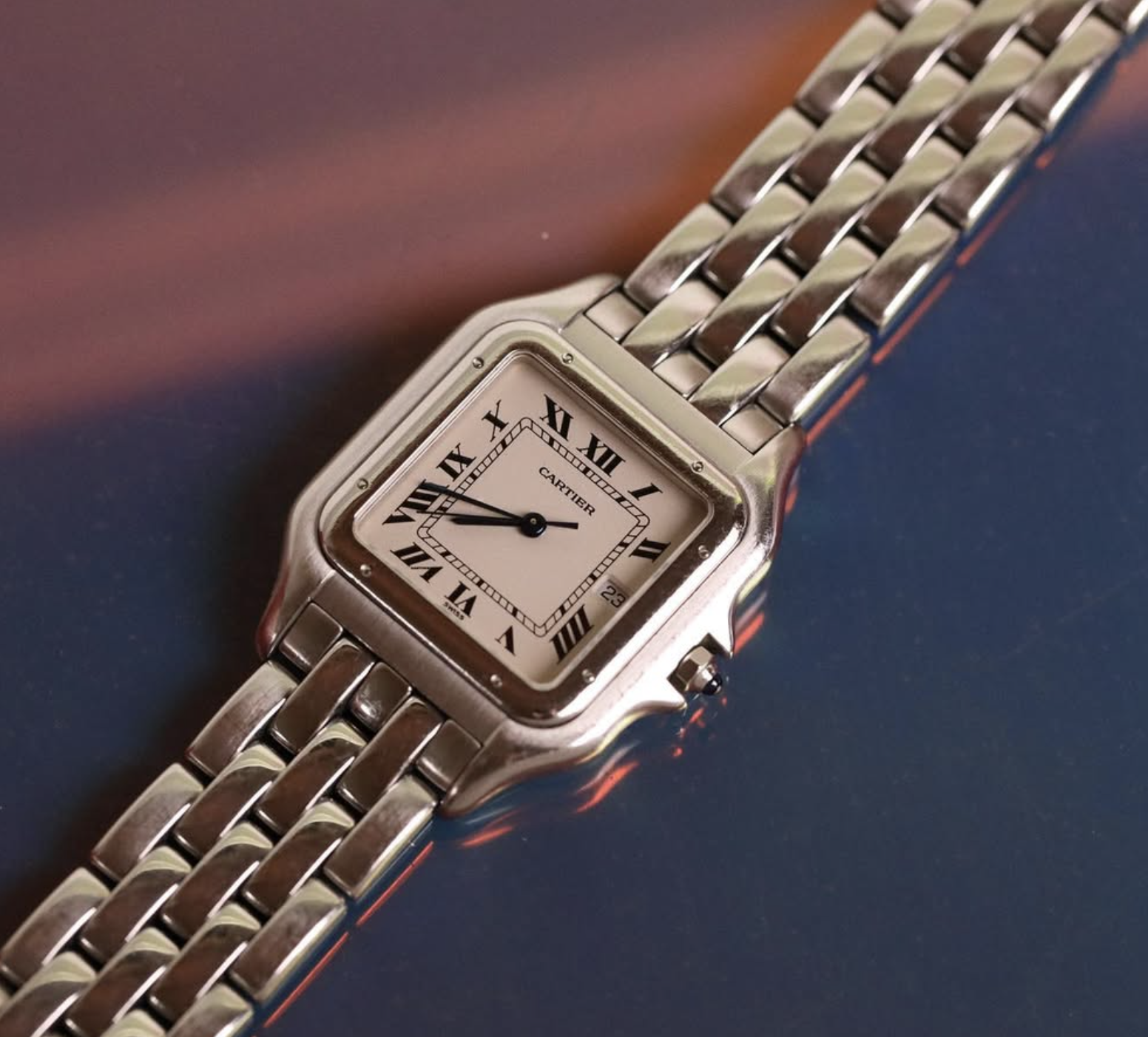
A microscopic 'CARTIER' hidden within the Roman numerals — present on every genuine post-1977 dial.
Cartier
The bracelet-integrated jewelry watch that democratized Cartier's precious metal codes.
Launched in 1983, the Panthère de Cartier represents a critical evolutionary moment in Cartier's watchmaking philosophy. It was the first major collection to synthesize the brand's iconic integrated-bracelet language—perfected in the Tank—with feminine-leaning proportions and a quartz movement accessible to a broader market than precious-metal mechanical watches allowed.
The name itself invokes the panther, Cartier's symbolic animal since the 1914 Panther brooch. Like that iconic jewel, the Panthère watch was conceived as jewelry first and watch second: a object of adornment rather than pure timekeeping. Yet its technical execution—the concealed butterfly deployant clasp, the sapphire crystal, the precision quartz movement—anchors this aesthetic ambition in genuine mechanical sophistication.
The early 1980s were a pivotal period for Cartier. The brand was consolidating its position as a luxury house that straddled fine jewelry and watchmaking. The Panthère emerged alongside a broader strategy to offer mechanical precision across price points, from the exclusive Manual-wound Tank Basculante to the newly accessible quartz-powered Panthère.
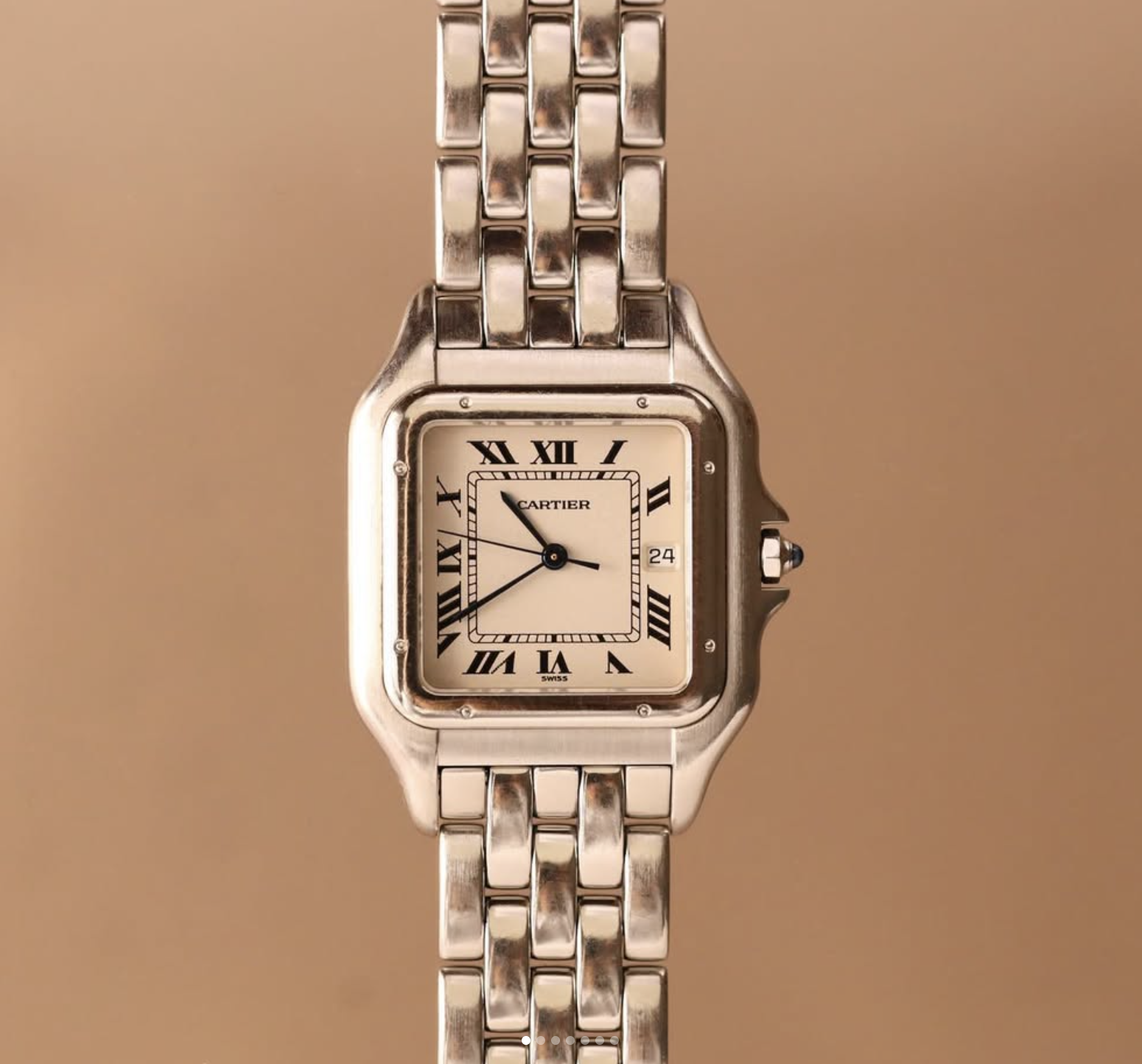
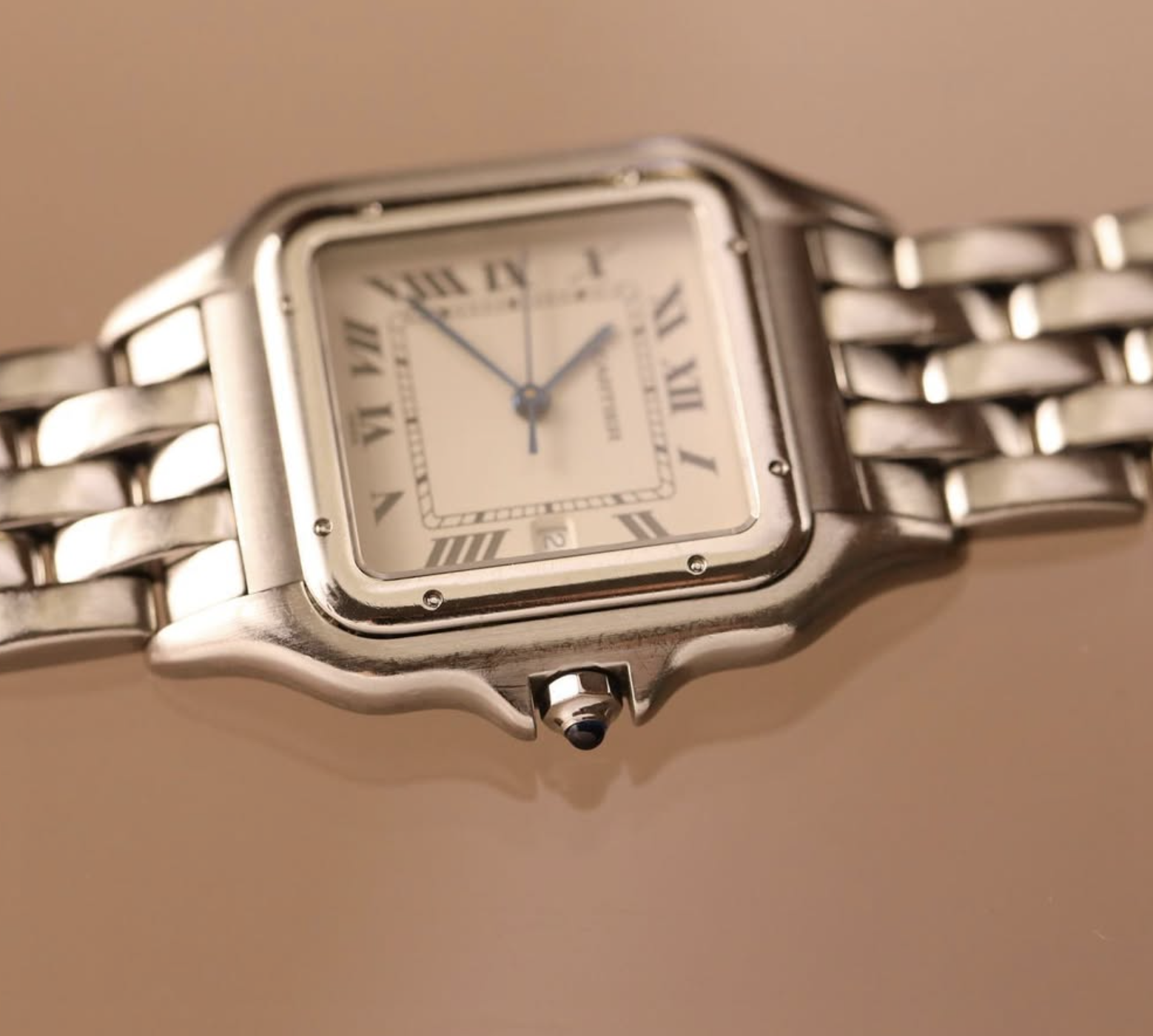
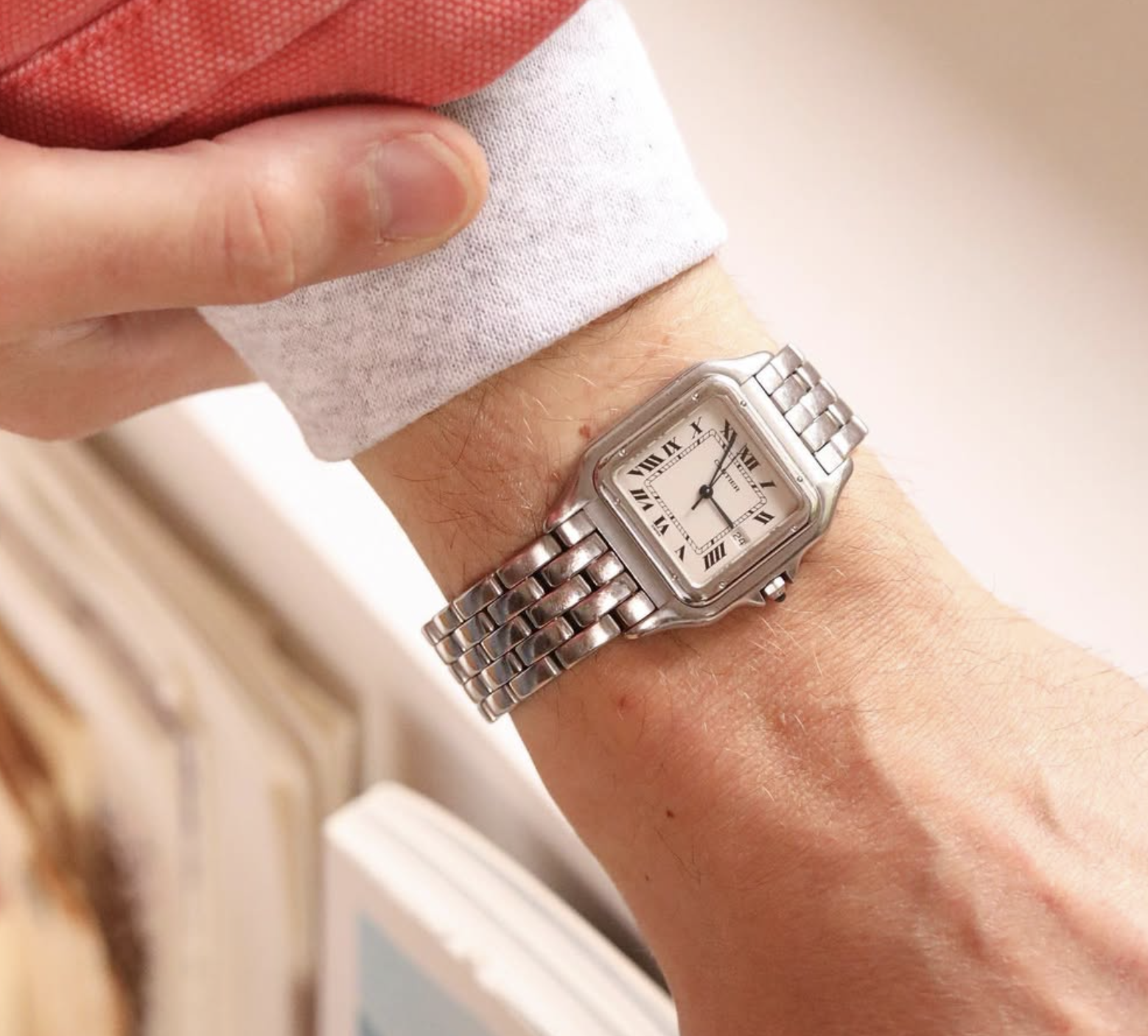
The Panthère's case architecture is deceptively refined. The rectangular tonneau body—approximately 29 × 22 mm in the iconic jumbo (Ref. 1300)—flows seamlessly into an integrated bracelet. Unlike the Tank, which uses separate lugs and bracelet links, the Panthère's bracelet appears to grow organically from the case. The lugs are integral to the case itself, creating a unified visual form.
The bracelet construction is proprietary to Cartier. Links alternate between polished and brushed stainless steel or 18k gold, creating a rhythmic light-play that reads as deliberately designed, not accidental. The polished surfaces catch and reflect light; the brushed surfaces ground the composition. Together, they create visual texture that justifies the watch's status as wearable art.
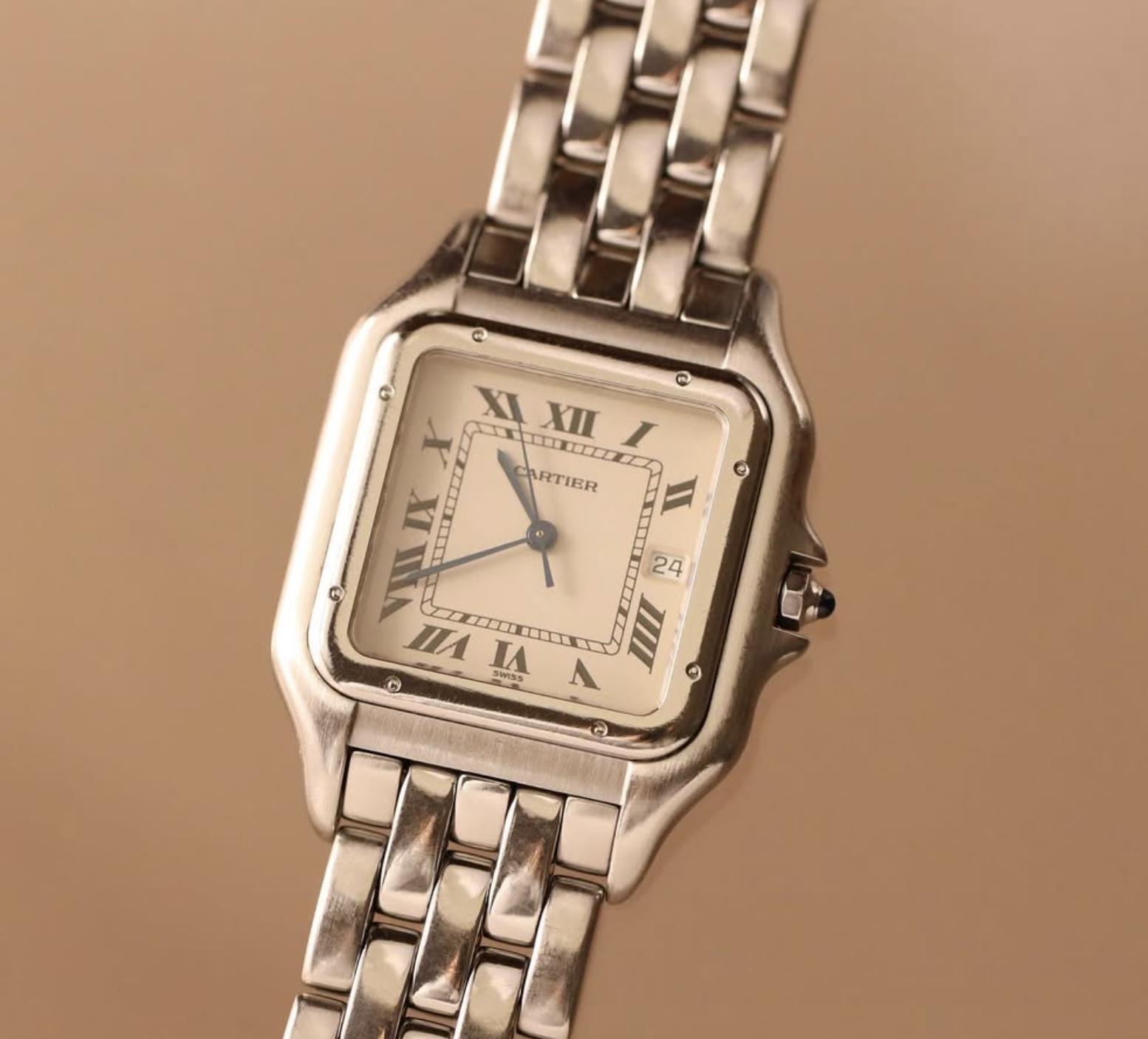
The dial maintains Cartier's classical vocabulary: cream or silver background, Roman numeral indices at cardinal positions, blue sword hands, and a sapphire cabochon crown the color of deep twilight. There is no date window, no complications, no narrative beyond the time and the visual language itself. This restraint is intentional—it positions the Panthère as a statement piece through form, not feature list.
The choice of quartz movement was strategic and democratic. At a moment when quartz technology was still viewed with some ambivalence by mechanical watch enthusiasts, Cartier positioned it as an advantage: the Panthère would be precise, reliable, and affordable. Cartier never publicly disclosed the caliber numbers for Panthère quartz movements—a detail that reflects both 1980s manufacturing secrecy and the brand's emphasis on the watch as a unified aesthetic object rather than a vehicle for mechanical signature.
This quartz architecture enabled the case sizes—particularly the smaller Ref. 1310 medium model—that would have been technically compromised with a mechanical movement of equivalent diameter. The quartz allowed Cartier to scale the design across three principal references (and variants within each) without sacrificing proportional harmony.
The original Panthère line was positioned as women's wear, following 1980s conventions that smaller watches were for female wrists. The Ref. 1300 jumbo (29 × 22 mm) was considered the women's sporty option; the Ref. 1310 medium (27 × 20 mm) was the everyday feminine size. The Ref. 107000 in 18k gold positioned prestige within that female-oriented lens.
This gendered framing is historically important to understand, though modern collectors have largely abandoned it. A Panthère looks equally compelling on any wrist proportional to its dimensions. What mattered—and still matters—is the visual logic of the proportions themselves, not the demographic assumptions of 1983 marketing.
The Panthère production run extended into at least the 2000s, though records are incomplete. Early production (c. 1983–1990) is marked by sharper finishing and more rigorous quality control. Mid-period variants (c. 1990–2000) show evidence of cost optimization—polishing may be slightly less reflective, bracelet tolerances slightly looser. Late production examples (2000+) become rarer and harder to date precisely.
The line never received the full-scale relaunch of the Tank or the Crash, though Cartier has continued to produce Panthère models (with modern quartz movements and, in some cases, updated case sizes) through the present day. For vintage enthusiasts, the original quartz-era production run from c. 1983–2000 is the definitive vintage window.
The Panthère's longevity stems from a rare balance: it is recognizable without being obvious, refined without being austere, and accessible without being compromised. It proved that Cartier could scale its design philosophy downward in price without diluting its visual authority. A Panthère from the 1980s reads as an artifact of its era—the cream dial, the quartz movement, the proportions all locate it precisely in time—yet the design language remains contemporary because Cartier's formal vocabulary is fundamentally classical.
For collectors today, the Panthère represents a moment when fine jewelry and practical watchmaking could genuinely coexist in a single object. It is neither pure jewelry (like Cartier's decorative pieces) nor pure watch (like the mechanical Tank). It is, instead, a bridge between them—and that bridge-quality is exactly why it endures.
Vintage Panthère examples are abundant enough that complete, well-preserved specimens are reasonably attainable. The market values originality above all: matching dial, original hands, functioning crown, and intact integrated bracelet. Ref. 1300 and Ref. 1310 in stainless steel are more common than Ref. 107000 in gold, which commands corresponding premiums.
Condition variation is significant. A museum-quality example with original box might command 2–3x the price of a worn daily-wear piece. However, the robustness of the quartz movement and the durability of the integrated bracelet mean that even well-used Panthères can be restored to excellent condition with conservative service.
The Panthère occupies a distinct category in Cartier's legacy: it is neither as architecturally pioneering as the Tank nor as culturally iconic as the Crash, yet it may be the most complete realization of Cartier's jewelry-watch concept. It deserves attention from anyone interested in luxury watchmaking at the intersection of fine art and mechanical function.
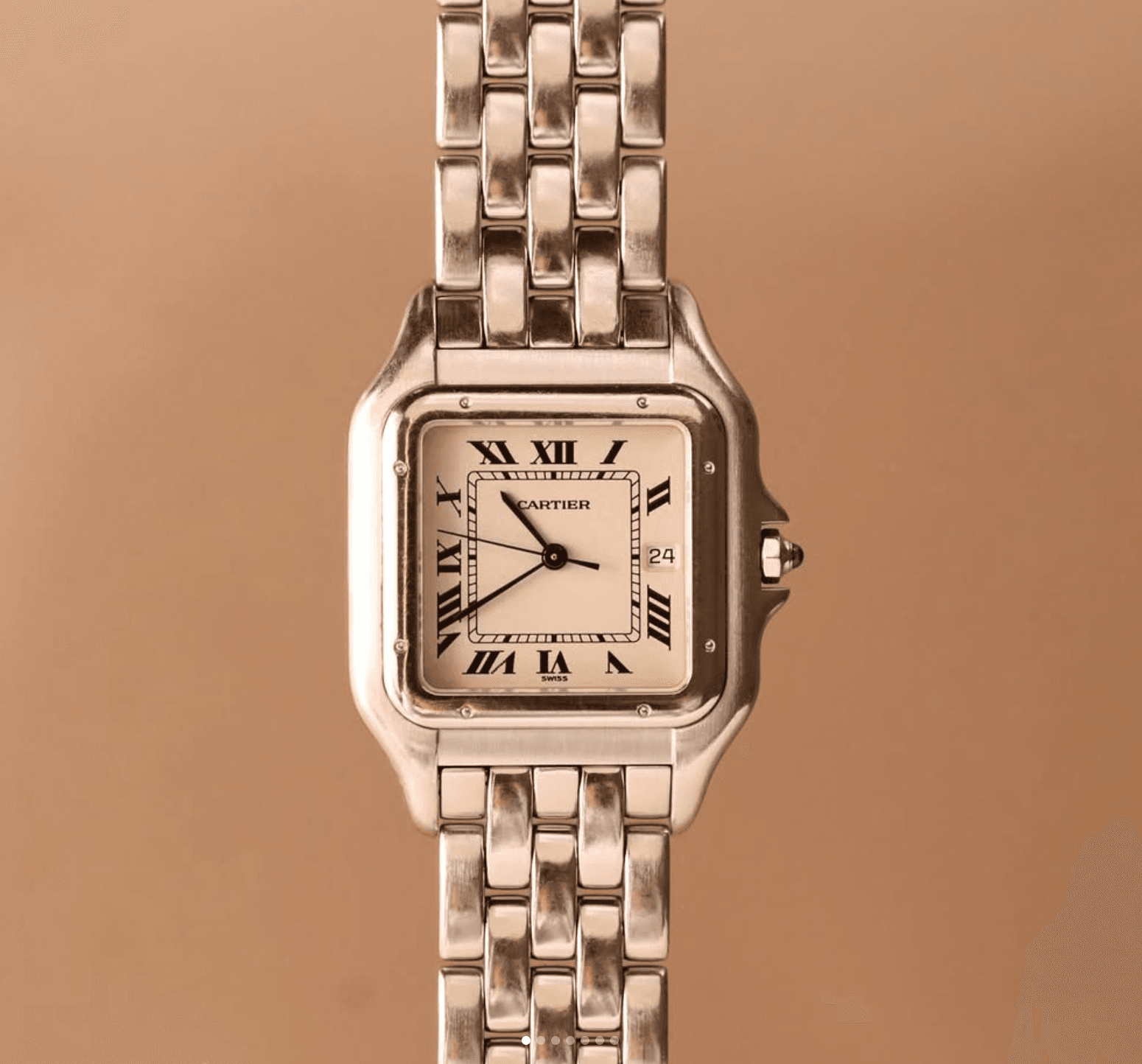
Ref. 1300 · c. 1983–2000s
The iconic Panthère Ref. 1300 in stainless steel with integrated bracelet and quartz movement — the model that proved Cartier could scale its jewelry-watch concept across price points without diluting its visual authority. At approximately 29 × 22 mm with polished and brushed link patterns, it established the Panthère as an accessible entry point to integrated-bracelet design for a generation of collectors. Clean examples with original cream dials and sapphire cabochon crowns remain robust daily wearers and represent genuine value in the vintage market.
5 documented references across 1 era
| Reference | |
|---|---|
| Ref. 107000 | |
| Ref. 1280 | |
 | Ref. 1300 |
| Ref. 1310 | |
| Ref. 8669 |
What every buyer, inheritor, and first-time collector should know.
Coming soon — vetted dealer listings for Panthère de Cartier.
Introduced 1977
A microscopic 'CARTIER' hidden within the Roman numerals — present on every genuine post-1977 dial.
Varies by era
Genuine Cartier cases bear specific hallmarks including the Cartier name, reference number, serial number, and precious metal assay marks. Placement and style varies by era, with earlier pieces showing different hallmark configurations than modern examples.
Varies by era and model
Cartier sourced movements from various Swiss manufacturers throughout history, including Jaeger-LeCoultre, Frédéric Piguet, ETA, and in-house production. Knowing the correct caliber for a specific reference is essential for authentication and establishing provenance.
A Cartier hallmark since the early 20th century
The blue sapphire (or spinel on less precious models) cabochon crown is a Cartier signature. Original crowns show consistent color saturation and are set flush with the crown body. Replacements often show misalignment or incorrect stone dimensions that reveal themselves under magnification.
Check the clasp first
Cartier bracelets carry their own reference markings and the deployment clasp should bear the Cartier name and logo. Aftermarket bracelets are extremely common on vintage pieces, so verifying clasp authenticity and matching reference numbers is crucial to overall authentication.
Patina tells the story
Vintage Cartier dials develop characteristic aging—cream dials warm to ivory, lacquer dials may develop fine crazing, and applied indices can show legible wear patterns. Understanding acceptable versus concerning dial aging is key to valuing a vintage piece authentically.
Coming soon — price trends and comparable sales for Panthère de Cartier.
Confirm your Panthère's reference number and production era using the identification guide. Understanding which variant you own helps assess current market value and preservation priorities.
START HERE →BUYERVerify reference number, movement function, bracelet integrity, and dial/hand originality before committing. Quartz-era Panthères are robust if well-maintained, but authentication points are critical.
CHECK BEFORE YOU BUY →SELLERDocument condition clearly: movement accuracy, bracelet wear patterns, dial printing sharpness, and crown function. Complete examples with original bracelets command premium pricing.
PRICE MY WATCH →