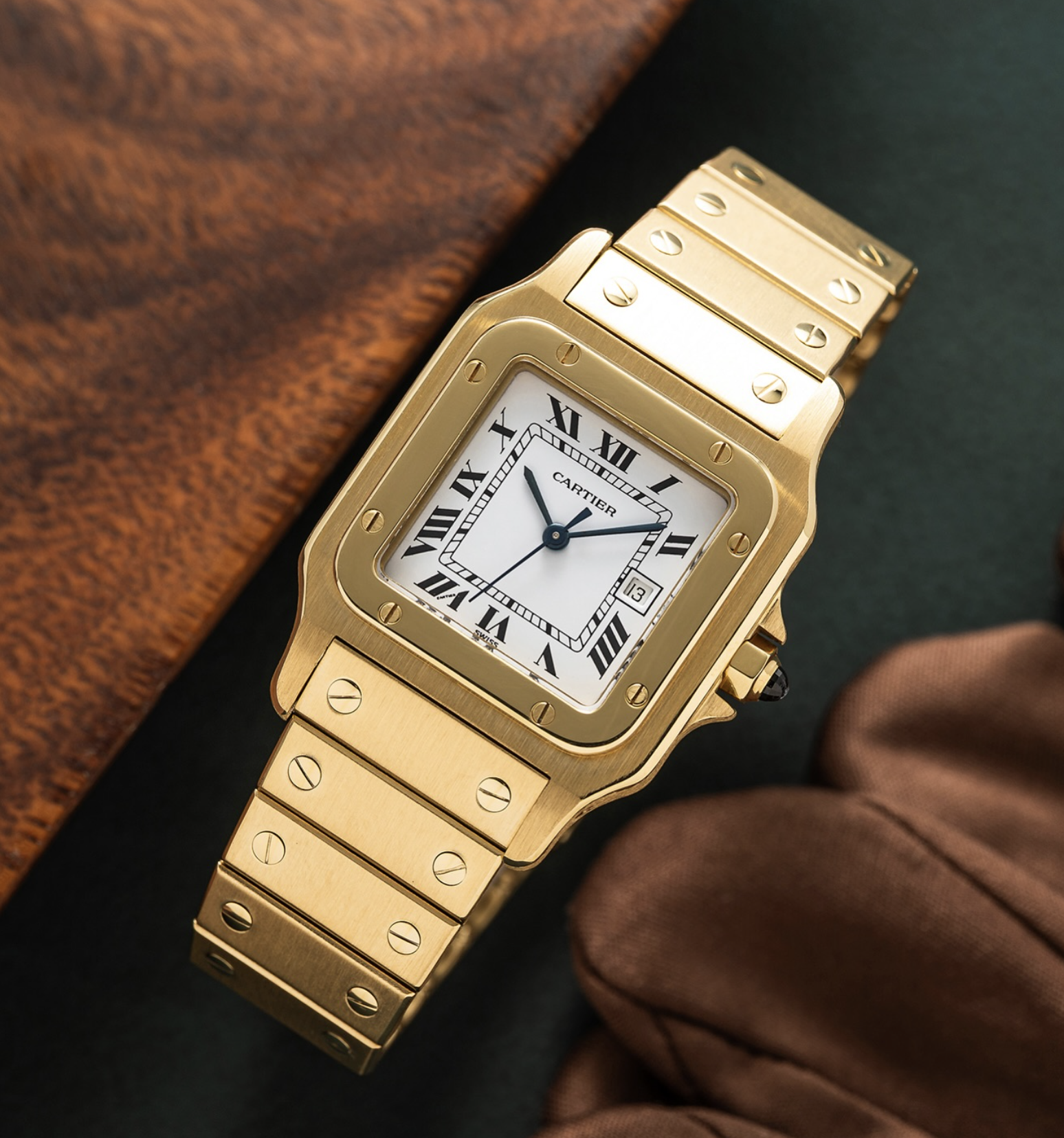
01DIAL
The Secret Signature
Introduced 1977
A microscopic 'CARTIER' hidden within the Roman numerals — present on every genuine post-1977 dial.
Cartier
The watch that introduced steel to Cartier — and launched the luxury sports watch category a decade before its competitors.
The Santos has the distinction of being revolutionary twice. In 1904, Louis Cartier created the original Santos for his friend Alberto Santos-Dumont — the piece that established the wristwatch as a serious object. But the Santos that collectors trade today descends from a second revolution: the 1978 relaunch that introduced stainless steel to the Cartier catalog and, in doing so, invented the luxury steel sports watch as a category.
On October 20, 1978, Alain-Dominique Perrin — then leading Cartier's commercial transformation — unveiled the new Santos at the Musée de l'Air in Paris, alongside Santos-Dumont's original Demoiselle aircraft. The choice of venue was deliberate: Perrin was connecting the new watch to aviation's pioneering spirit, not to the jewelry counter. The Santos would be Cartier's first watch in stainless steel, offered in a steel-and-gold combination that was daring for a maison whose identity was built on precious metals.
The relaunch Santos — sometimes called the Santos Carrée (square) to distinguish it from later variants — kept the essential DNA of the 1904 original: square case, exposed bezel screws, Roman numeral dial. But it was reimagined as a modern integrated-bracelet sports watch, following the template established by the Audemars Piguet Royal Oak (1972) and Patek Philippe Nautilus (1976). Where those watches were designed by Gérald Genta, the Santos's design authority came from its own history — the exposed screws on the bezel were not a stylistic choice but a direct quotation from the 1904 original.
The steel-and-gold combination proved transformative. It made Cartier accessible to buyers who would never have considered (or could not afford) an all-gold dress watch, while the 18k gold bezel and bracelet links preserved the maison's luxury positioning. The formula was so successful that it became heavily counterfeited throughout the 1980s — a reliable indicator of cultural impact in the watch world.
The 1978 Santos was produced in several configurations across its production run. The two-tone steel-and-gold model was the commercial backbone, but Cartier also offered all-gold versions in 18k yellow gold (the Ref. 2960) and all-steel versions for maximum accessibility. Ladies' models in smaller case sizes (notably the 24mm Ref. 0902) extended the line's reach.
By 1987, the Santos had evolved into the Santos Galbée — a refined version with softer, curved lugs and a more ergonomic bracelet. The Galbée became the primary Santos in the Cartier catalog, while the original Carrée form was gradually phased out. For collectors, this makes the pre-Galbée Santos Carrée references the historically significant pieces: they represent the original 1978 vision before commercial refinement smoothed its edges.
The vintage Santos market is driven by the same dynamics reshaping the broader neo-vintage segment. The 1978–1987 Carrée references — the original steel-and-gold automatics — represent the purest expression of Perrin's vision and carry the strongest collector premiums. All-gold variants like the Ref. 2960 are rarer and command higher prices, while the two-tone models offer the most historically representative ownership experience.
For new collectors, the Santos is one of the most accessible entry points into vintage Cartier. Prices remain well below equivalent-era Rolex sports watches, despite the Santos's arguably stronger claim to design originality. As the neo-vintage market continues to mature beyond the usual suspects, the 1978 Santos — the watch that made Cartier a player in steel — is increasingly recognized as one of the decade's most consequential designs.
Ref. 2960 · c. 1978–1990
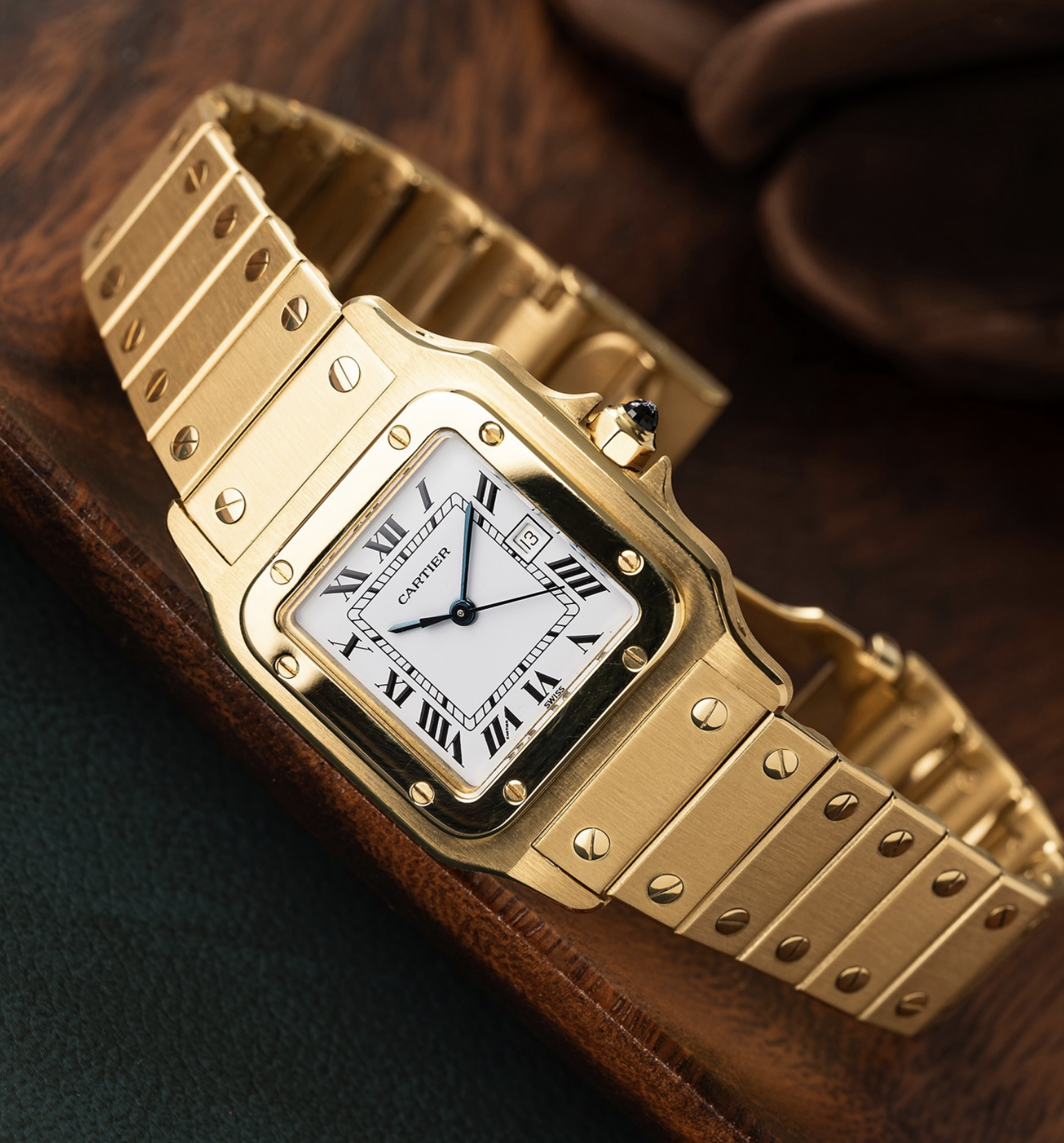
The Santos Carrée Ref. 2960 in solid 18k yellow gold — the most exclusive expression of Alain-Dominique Perrin's 1978 relaunch that introduced steel to Cartier and invented the luxury sports watch category a decade before Rolex's sports dominance. With exposed bezel screws, integrated bracelet, and manual or automatic movement, it established the definitive template for modern Santos collecting. Rarer than two-tone variants and commanding higher prices, the all-gold Santos Carrée remains undervalued relative to its design significance.
4 documented references across 1 era
| Reference | |
|---|---|
| Ref. 0902 | |
| Ref. 1575-1 | |
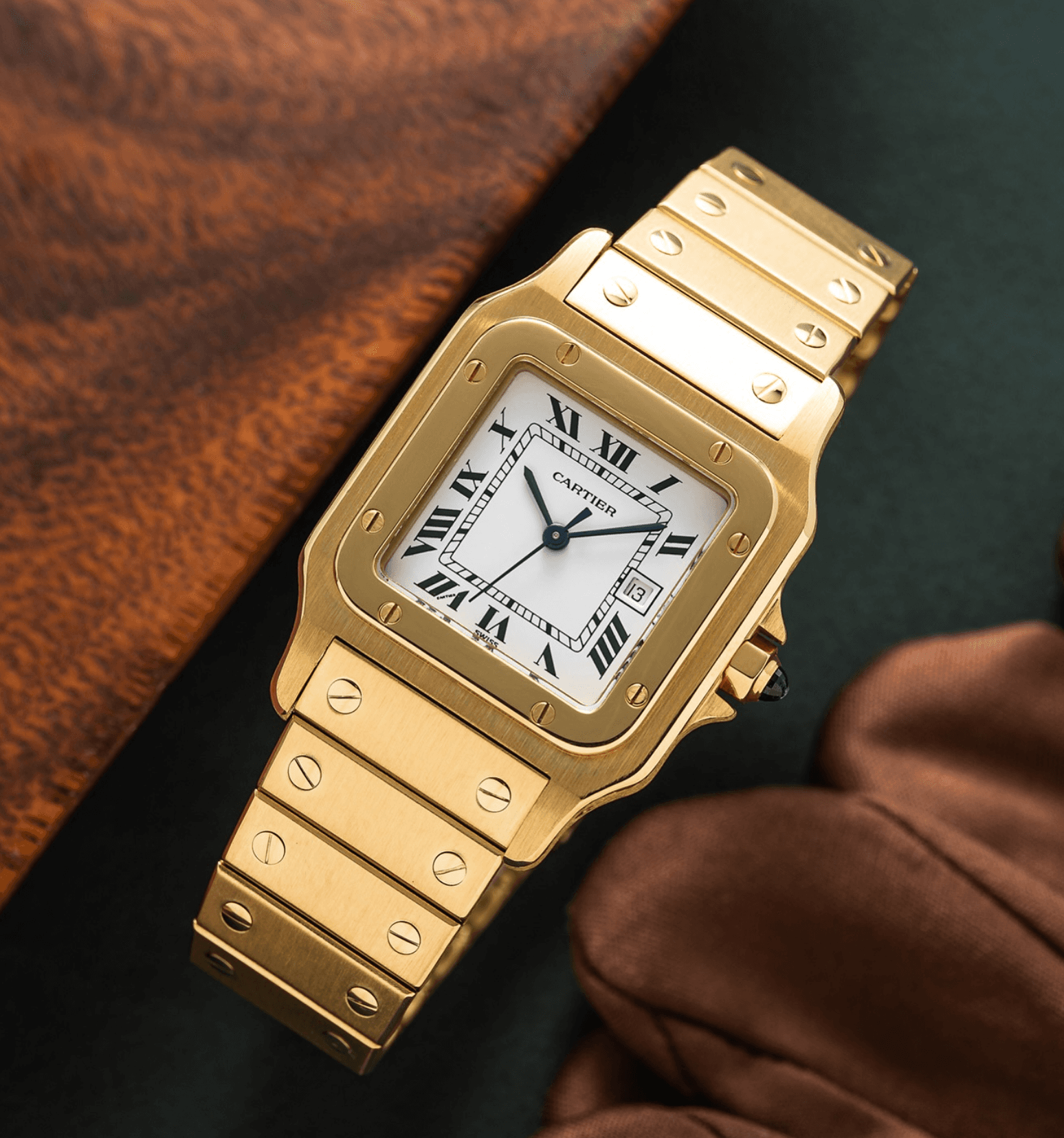 | Ref. 2960 |
| Ref. 987901-1 |
What every buyer, inheritor, and first-time collector should know.
Coming soon — vetted dealer listings for Santos.
Introduced 1977
A microscopic 'CARTIER' hidden within the Roman numerals — present on every genuine post-1977 dial.
Varies by era
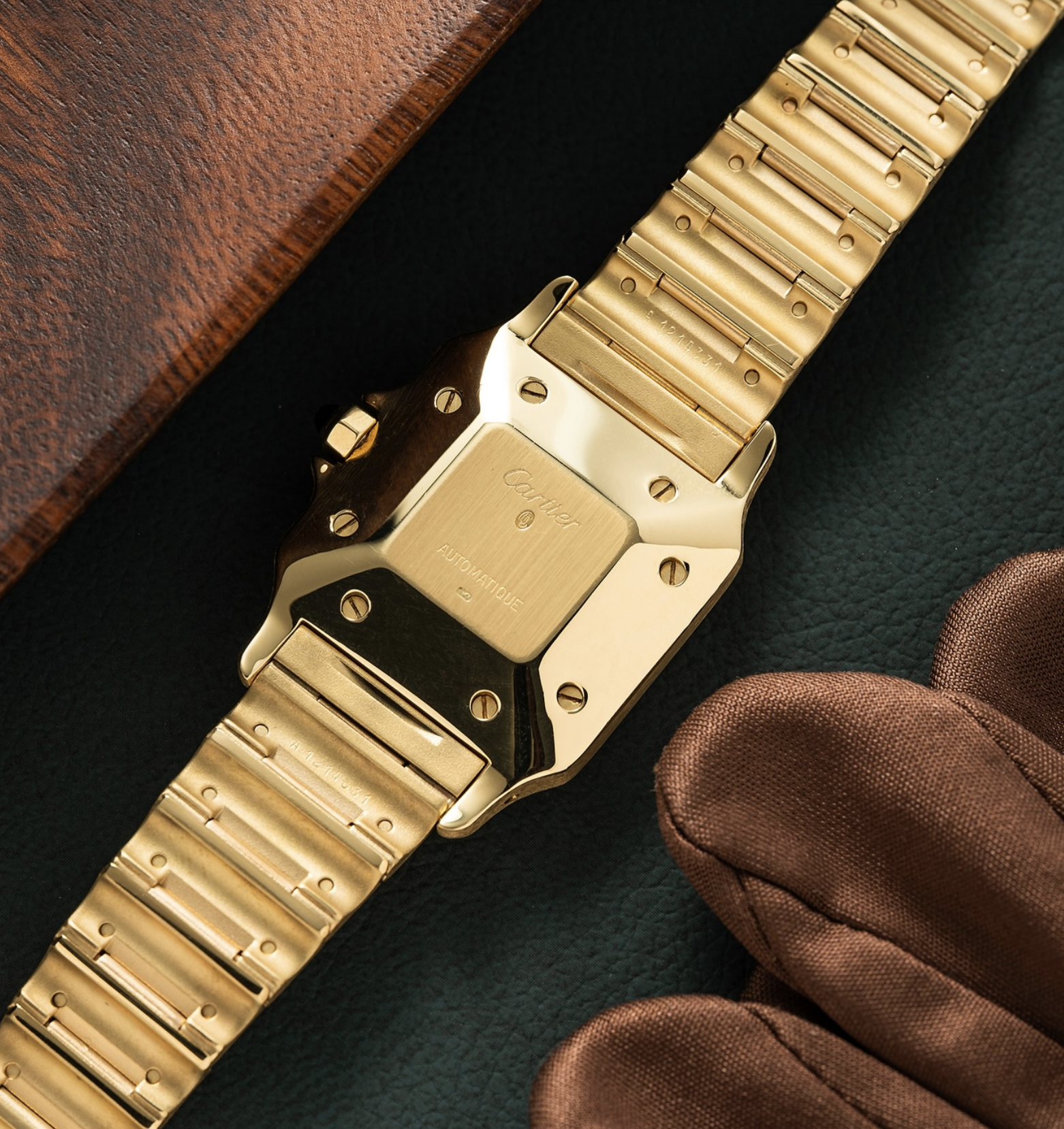
Genuine Cartier cases bear specific hallmarks including the Cartier name, reference number, serial number, and precious metal assay marks. Placement and style varies by era, with earlier pieces showing different hallmark configurations than modern examples.
Varies by era and model
Cartier sourced movements from various Swiss manufacturers throughout history, including Jaeger-LeCoultre, Frédéric Piguet, ETA, and in-house production. Knowing the correct caliber for a specific reference is essential for authentication and establishing provenance.
A Cartier hallmark since the early 20th century
The blue sapphire (or spinel on less precious models) cabochon crown is a Cartier signature. Original crowns show consistent color saturation and are set flush with the crown body. Replacements often show misalignment or incorrect stone dimensions that reveal themselves under magnification.
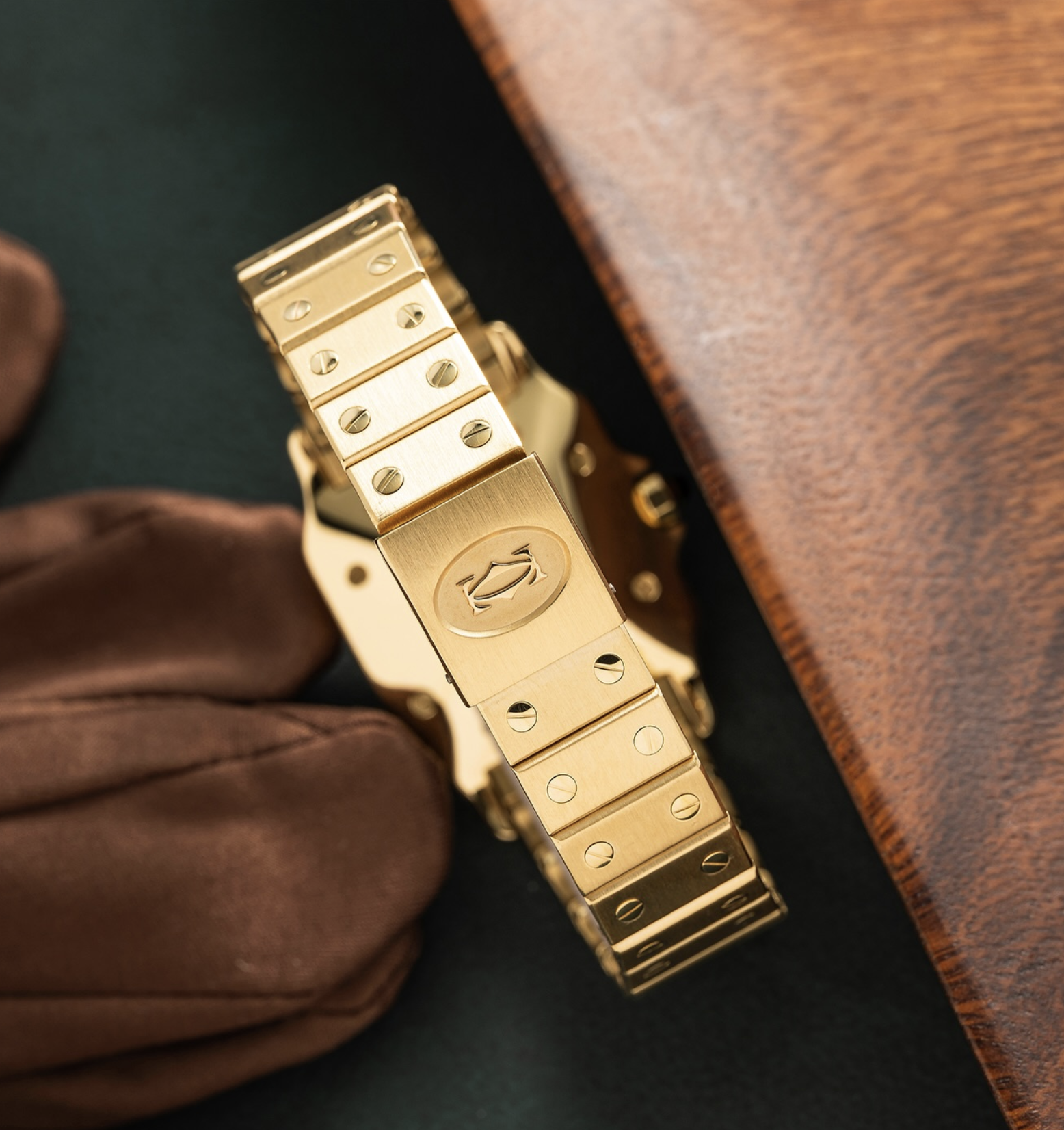
Check the clasp first
Cartier bracelets carry their own reference markings and the deployment clasp should bear the Cartier name and logo. Aftermarket bracelets are extremely common on vintage pieces, so verifying clasp authenticity and matching reference numbers is crucial to overall authentication.
Patina tells the story
Vintage Cartier dials develop characteristic aging—cream dials warm to ivory, lacquer dials may develop fine crazing, and applied indices can show legible wear patterns. Understanding acceptable versus concerning dial aging is key to valuing a vintage piece authentically.
Coming soon — price trends and comparable sales for Santos.
Identify which Santos reference you have, understand its era in the production lineage, and decide whether to keep, insure, or sell.
START HERE →BUYERKnow which references are vintage-eligible, what distinguishes a Carrée from a Galbée, and what to verify before purchasing.
CHECK BEFORE YOU BUY →SELLERPrice your Santos with current comparable sales, condition grading, and variant-specific value drivers.
PRICE MY WATCH →