Visual Description
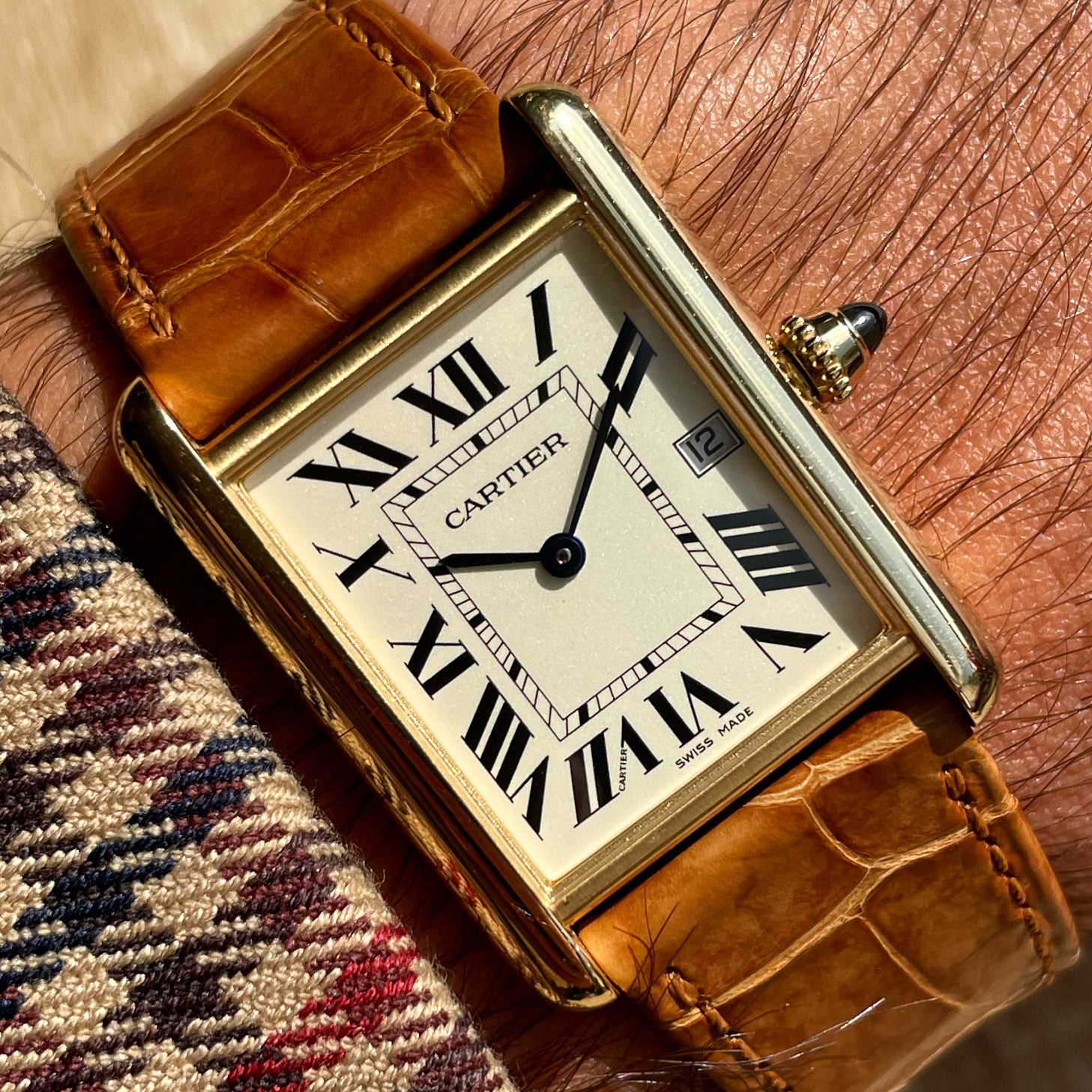
The Ref. 2441 presents the Tank Louis Cartier in its large-model configuration: a frosted white dial with black Roman numeral indices arranged along a railroad minute track, framed by the characteristic brancards in 18-karat yellow gold. A date aperture sits at the 3 o'clock position — a functional addition that distinguishes this reference from the time-only Tank Louis variants. Blued steel sword-shaped hands sweep across the dial beneath a sapphire crystal, and the crown is set with Cartier's signature blue spinel cabochon. The case back is secured by four screws.
Reference Significance
The Ref. 2441 occupies a specific niche in the Tank Louis Cartier lineage: it is the large-model, date-equipped quartz variant produced during Cartier's post-reunification era. While the earlier Ref. 78086 represents the hand-wound Parisian golden age, the 2441 reflects Cartier's transition into modern Swiss manufacture — reliable quartz timekeeping housed in the same 18k gold dress-watch form that defined the original Tank Louis.
For collectors, the 2441 is notable for its practicality. The date complication and quartz movement make it a daily-wearable Tank Louis without the twice-daily winding ritual. This pragmatism has historically kept prices below the mechanical references, but as neo-vintage collecting shifts attention toward 1990s and early-2000s production, the 2441 is drawing renewed interest — particularly examples with original dials showing honest aging.
The ladies' counterpart is the Ref. 2442, sharing the same design language in a smaller 22 × 29 mm case.
Historical Context
The Ref. 2441 was produced during a pivotal period for Cartier. The maison had reunified its three historic branches (Paris, London, New York) in the late 1970s and by the 1990s was consolidating production under a single manufacture structure. The 2441 represents Cartier's confidence that a quartz movement could coexist with haute horlogerie credibility — a position vindicated by the Tank Louis's enduring status regardless of what powers it.
At auction, the 2441 appears regularly at houses including Sotheby's. Examples in good condition with original dials, original buckle, and complete documentation command stronger results. The hidden Cartier signature within the VII numeral — a hallmark of authentic Cartier dials — is present on this reference and remains a key authentication detail.
What to Look For
The 2441's case dimensions (25.5 × 33.7 mm) and four-screw case back are consistent across production. Key authentication points include the blue spinel cabochon crown, the hidden "Cartier" signature within the VII Roman numeral, correct proportions of the railroad minute track, and the date window alignment at 3 o'clock. The case should show clean brancards with defined edges — over-polishing that rounds the brancards is one of the most common condition issues and reduces collector value.