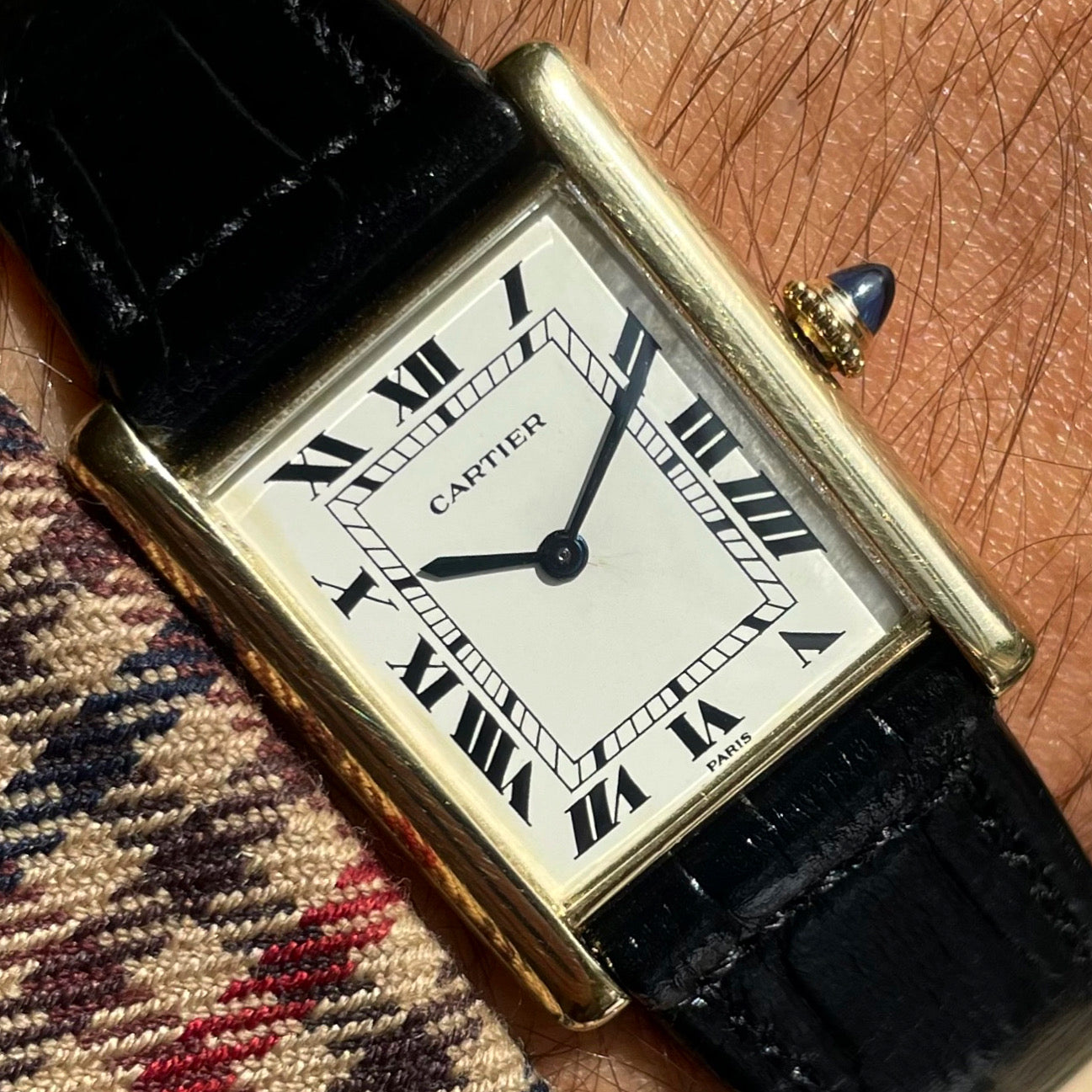
Visual Description
The Ref. 96019 is the Tank Louis at its most refined: an ultra-thin dress watch measuring approximately 4.9 mm in total thickness. The 18k yellow gold case carries the classic Tank Louis proportions — parallel brancards framing a white dial with painted black Roman numerals and a railroad minute track. The "CARTIER PARIS" signature at 12 o'clock (on earlier examples) identifies this as a piece from Cartier's Parisian workshops. Blued steel sword hands and a blue sapphire cabochon crown complete the dial in characteristic Cartier fashion. The Extra Plate designation is felt more than seen: on the wrist, the watch virtually disappears beneath a shirt cuff — which was precisely the point.
Reference Significance
The 96019 belongs to Cartier's "Extra Plate" family — a series of ultra-thin references from the 1970s that represent some of the most technically accomplished vintage Tanks. The Frédéric Piguet Cal. 21 that powers the 96019 is one of the finest ultra-thin manual-wind movements ever produced, a caliber shared with dress watches from Audemars Piguet and Vacheron Constantin. Housing it in the Tank Louis case created something that competed directly with the thinnest offerings from any maison — and did so in a design with stronger cultural recognition than almost any competitor.
Among vintage Tank Louis references, the 96019 occupies a tier above the standard quartz and thicker manual-wind models. It appeals to the collector who values mechanical purity and case thinness as primary criteria — the buyer who has already owned a quartz Tank and wants the next level of horological depth.
Historical Context
The 1970s were a transformative decade for Cartier's watchmaking identity. While the quartz revolution pushed many manufacturers toward electronic movements, Cartier doubled down on ultra-thin mechanical calibers as a luxury differentiator — a bet that the buyers who mattered most would pay for thinness achieved through engineering, not electronics. The Extra Plate references, powered by movements from Frédéric Piguet (later absorbed into Blancpain), were the flagship expression of this strategy.
The 96019 was produced from approximately 1970 through the early 1980s. Examples bearing the "CARTIER PARIS" dial inscription — indicating production or finishing at the Paris workshops — are particularly valued by collectors. As Cartier's manufacturing consolidated through the 1980s and the "PARIS" designation gave way to "SWISS MADE," the Paris-signed dials became markers of an earlier, more artisanal era.
A white gold variant of the 96019 exists but is substantially rarer than the yellow gold version. Documented examples appear occasionally at specialist dealers but are uncommon enough that confirming their existence required dedicated search.
What to Look For
The most critical authentication point is the movement. The Frédéric Piguet Cal. 21 should be present and correctly branded — this is the detail that distinguishes the 96019 from standard Tank Louis references. Some examples may carry the caliber designation P838 (18 jewels). A non-original movement — particularly a quartz replacement — fundamentally changes the watch's identity and value.
Case thickness is a quick field test: the 96019 should measure approximately 4.9 mm total. If it feels substantially thicker, confirm the reference number against the case back markings. Note that the case back on Extra Plate models uses screws positioned on the back rather than the sides, enabling the thinner profile.
Dial condition drives value significantly. The painted Roman numerals should be crisp and free of flaking. Paris-dial examples (bearing "CARTIER PARIS" rather than "CARTIER" alone or "SWISS MADE") command a 10–20% premium. Replacement or refinished dials — identifiable by inconsistent paint quality, incorrect font spacing, or misaligned text — reduce value substantially.
The mineral crystal (rather than sapphire) is period-correct for 1970s production. A sapphire crystal may indicate a later service replacement — not necessarily a negative, but worth noting when evaluating originality.