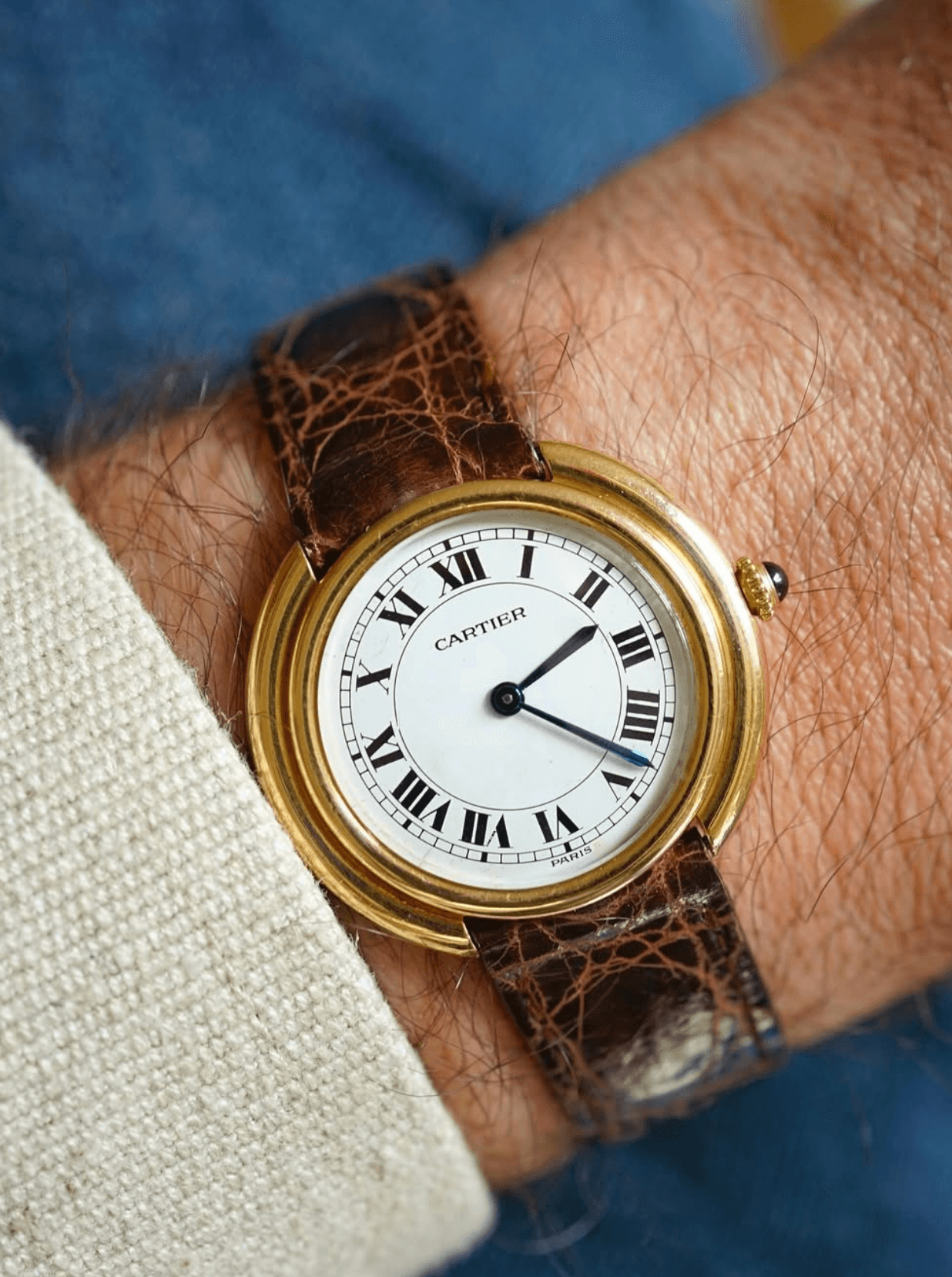
01DIAL
The Secret Signature
Introduced 1977
A microscopic 'CARTIER' hidden within the Roman numerals, present on every genuine post-1977 dial.
A small round vermeil quartz watch from the Must de Cartier line, cataloged at auction from about 1988.
The Colisée belongs to Les Must de Cartier, the vermeil line Cartier launched in the mid-1970s alongside its solid gold collections; the Tank Must page covers the line's origins. Must watches are cased in vermeil, sterling silver plated with gold, rather than solid gold.
The Colisée is a small round Must watch. The one reference documented at auction, the Ref. 590002, is 24 mm with a smooth bezel, a crown set with a blue cabochon and a quartz movement. Aguttes catalogs it as the Must de Cartier Colisée, circa 1988, with a cream Roman numeral dial, and a Paris house sale on Interencheres offered one in November 2025, circa 1990, with a white dial worked in gold, silver and copper tones.
The Colisée sits beside the Must Vendômes in the same numbering: the 24 mm Ref. 590004 and the 30 mm Ref. 590003, both vermeil and quartz. The 590004 is the same size and metal as the Colisée, so the case back number is the surest guide.
Ref. 590002 · c. 1988–1990
Reference photography unavailable.
Want to sponsor this reference with your studio photography? Become a sponsor
The Ref. 590002: a 24 mm round case of gold-plated sterling silver with a smooth bezel and a blue cabochon crown, on a quartz movement. Aguttes catalogs one with a cream Roman numeral dial, circa 1988, and a Paris sale offered another with a three-tone dial, circa 1990.
1 documented reference across 1 era
| Reference | |
|---|---|
| Ref. 590002Vermeil (925 sterling silver with gold plating) · Quartz |
What every buyer, inheritor, and first-time collector should know.
Introduced 1977
A microscopic 'CARTIER' hidden within the Roman numerals, present on every genuine post-1977 dial.
Varies by origin and era
A Cartier case carries the Cartier signature, a reference and serial number on later pieces, and small struck marks for the metal and the case maker. Which marks appear depends on where the case was made: an eagle's head on Paris gold, JC and a date letter on London cases, the Helvetia head on Swiss 18k before 1995. The hallmarks guide shows what each one means.
Varies by era and model
Cartier sourced movements from various Swiss manufacturers throughout history, including Jaeger-LeCoultre, Frédéric Piguet, ETA, and in-house production. Knowing the correct caliber for a specific reference is essential for identifying the watch and establishing provenance.
A Cartier hallmark since the early 20th century
The blue sapphire (or spinel on less precious models) cabochon crown is a Cartier signature. Original crowns show consistent color saturation and are set flush with the crown body. Replacements often show misalignment or incorrect stone dimensions that reveal themselves under magnification.
Check the clasp first
Cartier bracelets carry their own reference markings and the deployment clasp should bear the Cartier name and logo. Aftermarket bracelets are extremely common on vintage pieces, so checking that the clasp is original and that reference numbers match is crucial to the overall picture.
Patina tells the story
Vintage Cartier dials develop characteristic aging: cream dials warm to ivory, lacquer dials may develop fine crazing, and applied indices can show legible wear patterns. Understanding acceptable versus concerning dial aging is key to valuing a vintage piece accurately.
Direct answers about the Must de Cartier Colisée, drawn from the reference records below.
Read the number on the case back to confirm you have a Colisée, then check the vermeil plating and the dial.
START HERE →BUYERKnow how to tell the Colisée from the Must Vendôme, which dials are documented, and how to spot plating wear.
CHECK BEFORE YOU BUY →SELLERStart with the reference, the dial and the condition of the plating, and gather any box and papers.
PRICE MY WATCH →