01DIAL
The Secret Signature
Introduced 1977
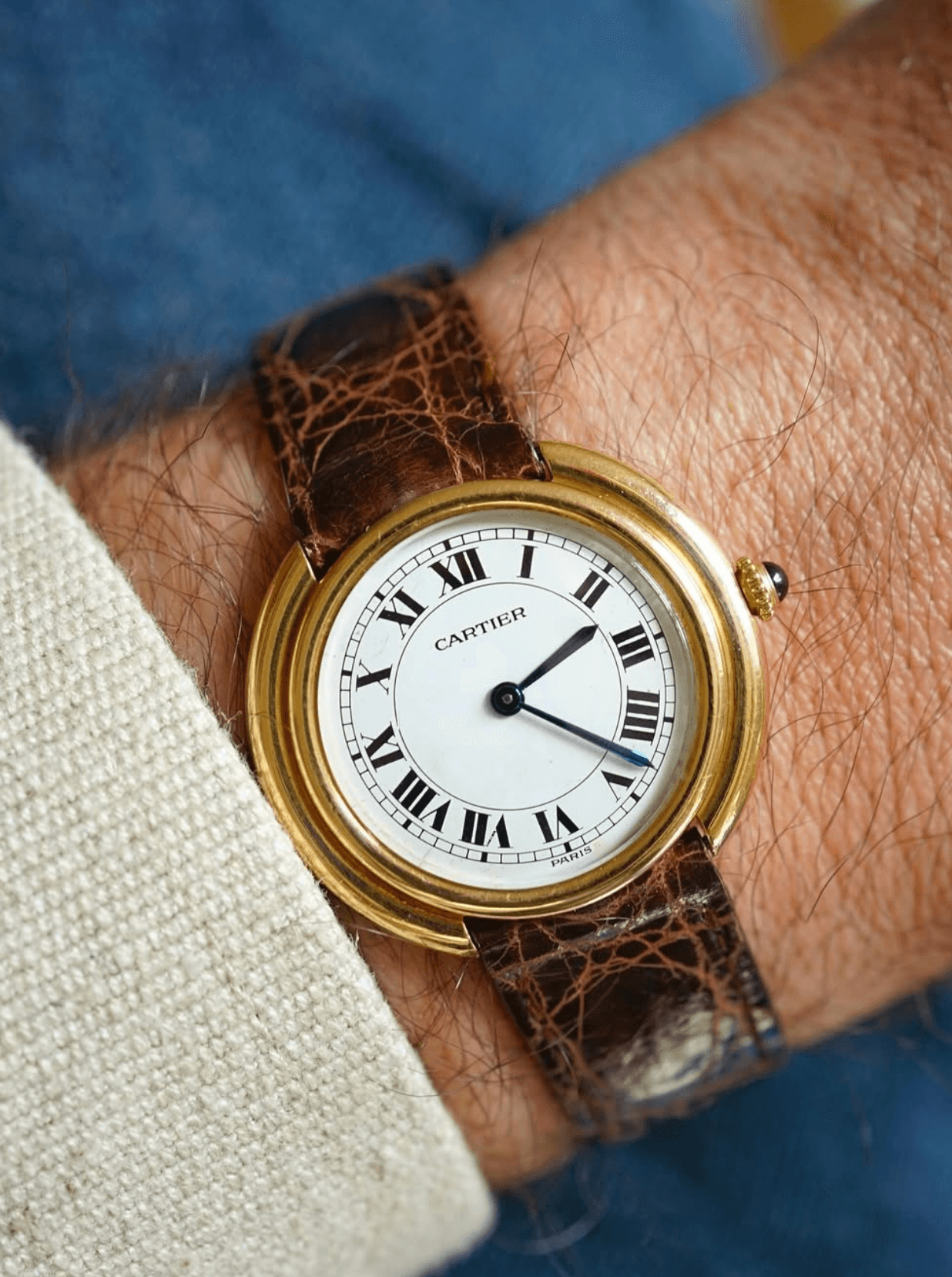
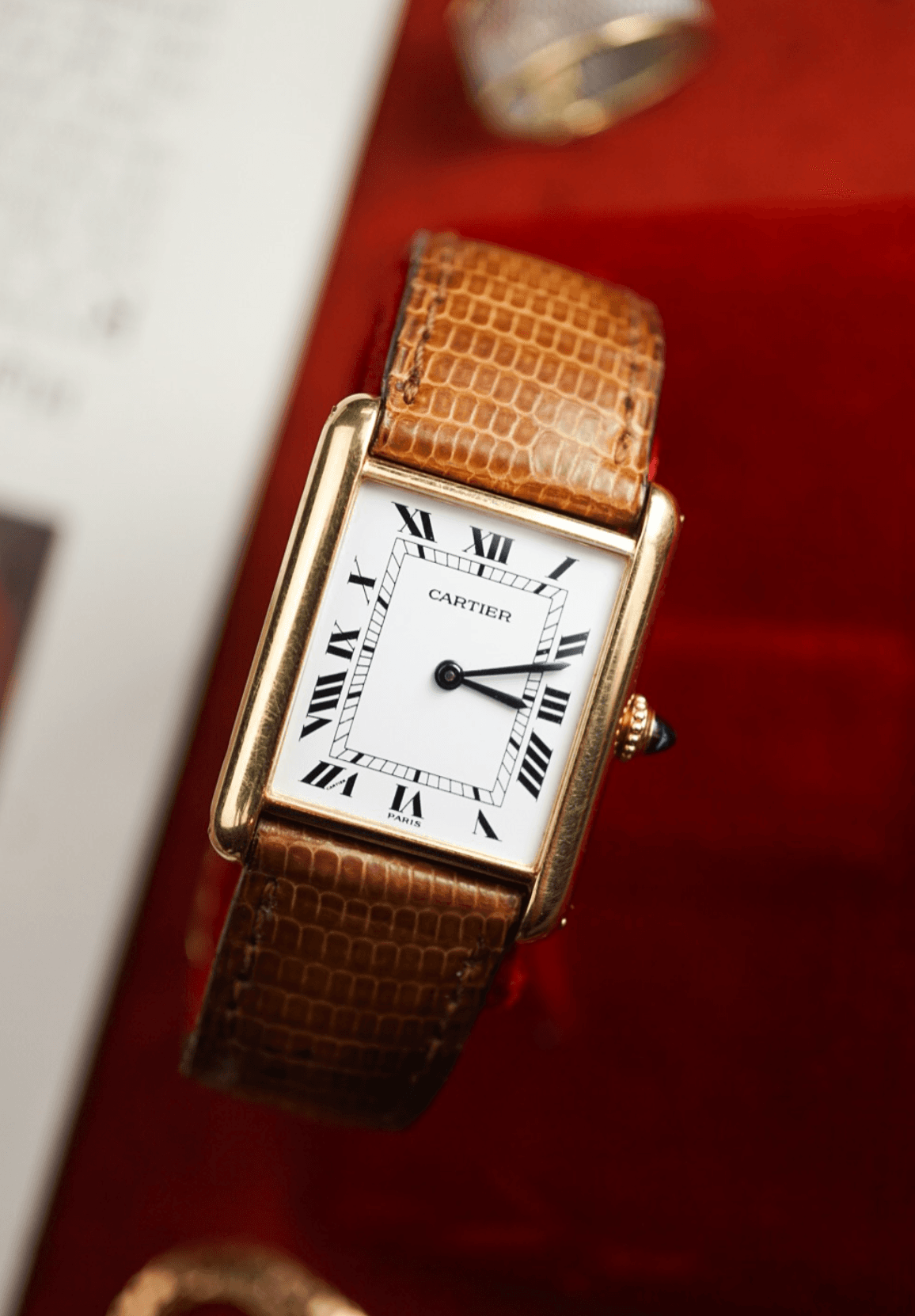
A microscopic 'CARTIER' hidden within the Roman numerals, present on every genuine post-1977 dial.
A stepped gold oval laid on its side, flat at the top and bottom and swelling at the sides, introduced in the 1973 Louis Cartier Collection in a large and a small size.
The Ellipse was one of the shapes Cartier introduced in 1973 with the Louis Cartier Collection. Phillips and Analog/Shift date the collection to that year, and Loupe This dates the Ellipse itself to 1973. Craft + Tailored writes that it arrived alongside the Cristallor, the Gondole and the Vendôme. The Ellipses documented from those years are 18k gold and hand-wound, with dials signed Paris.
The Ellipse is an oval laid on its side. Phillips describes a horizontally oriented oval case, Analog/Shift a slim, horizontal watch, and Loupe This a case whose flat top and bottom echo the Tank while its curved sides swell outward. The case is stepped toward the dial. The dial is white enamel with black Roman numerals and a railroad minute track, signed Paris at 6 o'clock, with blued sword hands, and the large model has a crown set with a blue sapphire cabochon.
The Ref. 78091 is the large Ellipse, about 32 × 29 mm, on the hand-wound Cartier Cal. 78-1, which Amsterdam Watch Company describes as based on the ETA 2512. It is documented in 18k yellow gold, in 18k white gold, and with onyx and diamonds on the bezel.
The Ref. 67081 is the small Ellipse, about 26 × 23 mm, on the hand-wound Cal. 2412 with 17 jewels. Phillips calls it the smaller version of the 78091 and writes that it was offered in white or yellow gold, with a two-tone Deux Ors version from the mid-1970s. The plain yellow gold case is the one seen most often, and Phillips and Monaco Legend have sold examples set with diamonds, mother-of-pearl, rubies and yellow diamonds.
The numbers of both sizes sit beside those of the round Vendôme: the 33 mm Vendôme is the 78090 and the 26 mm one the 67080. Phillips writes that quartz Ellipse models followed in the 1980s.
Dated examples of both references run from the 1970s into the 1980s. The Ellipse appears regularly at auction in Monaco, Hong Kong and Paris and with specialist dealers, more often in yellow gold than any other metal. Its names are not settled in the market: some listings call it the Ellipse Gondole, and one catalog has called a round Vendôme an Ellipse Vendôme, so the shape of the case and the number on its back are the surest guide.
Ref. 67081 · c. 1975–1980s
Reference photography unavailable.
Want to sponsor this reference with your studio photography? Become a sponsor
The Ref. 67081 is the small Ellipse: a horizontal oval 18k gold case about 26 × 23 mm, a white enamel Roman numeral dial signed Paris, blued sword hands and the hand-wound Cal. 2412 with 17 jewels. Phillips, Monaco Legend and Artcurial have all cataloged it, in plain gold and set with diamonds, mother-of-pearl or rubies.
2 documented references across 1 era
| Reference | |
|---|---|
| Ref. 6708118k Yellow Gold · Manual | |
| Ref. 7809118k Yellow Gold or 18k White Gold · Manual |
Choose your reference, set its condition, and see what it's likely to bring. Each estimate uses sales of that exact reference where there are enough of them.
The typical public example: light wear, original-looking dial, runs well. This is the baseline.
One sale of Ref. 78091: $6,400 at Antiquorum Hong Kong, Nov 2025. Too few to estimate from.
| Date | Ref. | Where | Details | Counts as | Price |
|---|---|---|---|---|---|
| Nov 2025 | 78091 | Antiquorum Hong KongAuction | Important Modern & Vintage Timepieces, lot 19, 30 Nov 2025. 18k yellow gold, case 2224, cal. 2512-1, Paris dial. | This reference | HK$50,000≈ $6,400 |
Sales from November 2023 to November 2026, or from the last five years for a reference with fewer than three in that time. Only sales that name a reference count toward its estimate; sales of the rest of its version are shown for comparison and never folded in. Auction prices include the buyer's premium unless a row says hammer; dealer prices are the price at sale. Hong Kong dollar and euro figures are converted at a rate near each sale date. Results are from the auction houses' own lot pages. Monaco Legend figures include the buyer's premium; Antiquorum and Phillips show a sold figure without stating it. Gem-set cases are listed but not counted. The condition and option adjustments, the expected bid (75 to 85% of market value) and the auction range (62 to 72%) are working assumptions, to be replaced by Archiva's own bids as they come in. A sale far above or below the other sales of its reference is listed but not counted, so one unusual result can't pull the estimate. An estimate from public results, not an appraisal.
What every buyer, inheritor, and first-time collector should know.
Introduced 1977
A microscopic 'CARTIER' hidden within the Roman numerals, present on every genuine post-1977 dial.
Varies by origin and era
A Cartier case carries the Cartier signature, a reference and serial number on later pieces, and small struck marks for the metal and the case maker. Which marks appear depends on where the case was made: an eagle's head on Paris gold, JC and a date letter on London cases, the Helvetia head on Swiss 18k before 1995. The hallmarks guide shows what each one means.
Varies by era and model
Cartier sourced movements from various Swiss manufacturers throughout history, including Jaeger-LeCoultre, Frédéric Piguet, ETA, and in-house production. Knowing the correct caliber for a specific reference is essential for identifying the watch and establishing provenance.
A Cartier hallmark since the early 20th century
The blue sapphire (or spinel on less precious models) cabochon crown is a Cartier signature. Original crowns show consistent color saturation and are set flush with the crown body. Replacements often show misalignment or incorrect stone dimensions that reveal themselves under magnification.
Check the clasp first
Cartier bracelets carry their own reference markings and the deployment clasp should bear the Cartier name and logo. Aftermarket bracelets are extremely common on vintage pieces, so checking that the clasp is original and that reference numbers match is crucial to the overall picture.
Patina tells the story
Vintage Cartier dials develop characteristic aging: cream dials warm to ivory, lacquer dials may develop fine crazing, and applied indices can show legible wear patterns. Understanding acceptable versus concerning dial aging is key to valuing a vintage piece accurately.
Direct answers about the Cartier Ellipse, drawn from the reference records below.
Measure the case and read the number on the back: the 78091 is the large Ellipse, about 32 × 29 mm, and the 67081 the small one, about 26 × 23 mm. Then check the movement and dial.
START HERE →BUYERListings mix the Ellipse up with the Vendôme and the Gondole. Check the shape of the case and the number on the back, then the movement and the dial.
CHECK BEFORE YOU BUY →SELLERGather the reference and case number, photographs of the movement and dial, and any Cartier box or repair papers, then compare recorded sales of the same reference.
PRICE MY WATCH →